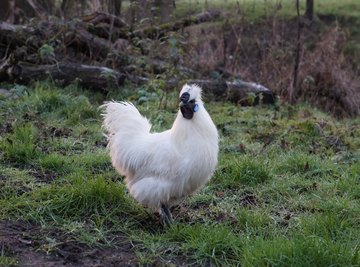
In a crowd of chickens, Silkie Bantams stand out, with their fluffy fine plumage. These docile chickens make ideal pets, and their exceptionally broody behavior makes them attentive mothers. The 21st century has thus far marked Silkies as one of the most popular ornamental breeds.
SIlkie History
The breed is believed to have originated in China or Japan. Marco Polo stumbled across Silkies in 1298, during his travels in Asia and provided the world with the first documentation of this unique poultry breed, according to Oklahoma State University Department of Animal Science. History also indicates that these odd-looking chickens have roots in India and Malay.
Description
The name “silkie” comes from the birds’ feathers, which do not adhere to one another and give the appearance of looking like silky hair. Two other features remain unique to Silkies, namely their black-pigmented skin and turquoise ear lobes, writes Oklahoma State University Department of Animal Science. Their feet bear 5 toes, and a plume, or crest, of wispy feathers stand up on their heads. The silky feathers cover every inch of these birds’ bodies, including their feet, giving the appearance of two-footed, furry Clydesdale.
Bantams
Due to their small size, Silkies fall under the category of bantam. Bantams, according to the University of Illinois Extension, “are miniature chickens usually about one-fourth to one-fifth the weight of their large counterparts, when such exist.” The existence of an unlimited assortment of colors, color patterns and types of bantams has made this part of chickendom become known as the flower garden of the poultry world, writes the University of Illinois Extension.
Bearded Silkie
The presence of beards on some Silkies mark them out as an anomaly as far as chickens go. These beards, like feather muffs, cover the earlobes and flow down below the beak of both male and female chickens. Feathers protruding from both sides of the beak, the center and vertically down turning backwards horizontally to compose a collar formed of three oval parts, according to Oklahoma State University Department of Animal Science. Bearded varieties easily distinguish themselves from non-bearded ones, as the presence of a beard completely surrounds the face of a chicken, leaving only a black beak poking out from a sea of fluff.
Non-Bearded Silkie
Non-bearded Silkies share the same overall dimension and form as bearded Silkies. The only exception lies on the face, where without the presence of a fluffy beard, the face, turquoise earlobes and wattle become apparent.
References
Resources
About the Author
A Kansas-based writer, Alecia Stuchlik has been writing since 2007. Her articles have appeared in “K-State’s Statements” and “Manhattan Magazine.” She has a Bachelor of Arts from Kansas State University in anthropology and English.