

How to Tap Into a Basement PVC Drain Pipe

PVC pipe, a plastic pipe used for both water supply as well as drainage, is fairly straightforward for the homeowner to work with and a favorite of professional plumbers. It is easy to cut and tap or merge another line into for any additions or remodeling projects.
-
Place the bucket under the pipe where you will cut to join the new PVC drainage pipe to the existing PVC pipe in the basement.
-
Cover the side outlet of the tee fitting with masking tape to protect it while assembling it to the existing pipe. The tee fitting is shaped like a "T" where the crossbar of the "T" is the main body, and the bottom left of the "T" is the side outlet.
-
Hold the tee fitting up to the existing pipe where you will install it. Use the pen to mark the ribbed edges on the pipe where the end of each pipe (when cut) will slide into the fitting and abut against those ribbed edges forming a tight seal. This is usually about 2 to 3 inches depending on the size of the fitting. Mark directly onto the pipe to indicate where it will be cut.
-
Cut the pipe on those marks, using the hacksaw. Remove the small piece of pipe or allow it to fall away as you cut it loose. Allow any remaining or standing water in the drainage pipe to drain into the bucket.
-
Scrap away any plastic shavings on each end of the pipe using a utility knife. Wipe the end of each pipe using the cloth rag to dry it and remove any debris. The ends of the pipe must be clean for the cement to fully adhere to the pipe to form a leakproof seal.
-
Apply cement to the outside of each end of the pipe and to the inside of each end on the tee fitting. Slide the tee fitting onto each end of the pipe and allow the cement to set.
-
Remove the tape from the side fitting. Apply cement around the inside end of the side fitting and the outside end of the new drainage pipe. Insert the PVC pipe from the new drainage pipe into the side fitting on the tee fitting to complete the connection of the new drainage into the old drainage.
References
Resources
Tips
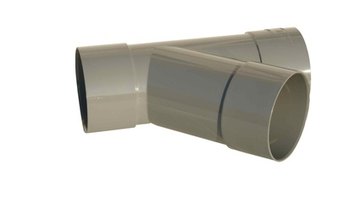
- You can also use a "Y" fitting for the side fitting. A "Y" fitting has a 45-degree angle rather than a tee fitting, which is a 90-degree angle.
Warnings
- Avoid bringing your skin into contact with the PVC cement as it can cause irritation or burns.
Writer Bio
Laurie Brown has worked as a high school English teacher for the last several years and loves writing. She enjoys helping her students develop a love and appreciation for writing, reading, and literature. Laurie has a degree in education with a major in English. Currently she is a writer for eHow.
Photo Credits
- te en pvc 45° image by Marie-Thérèse GUIHAL from Fotolia.com
More Articles

