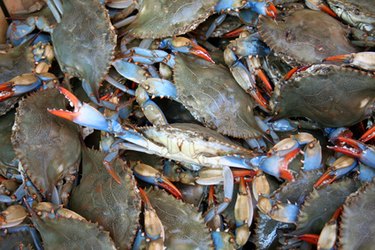
Blue crabs are named for their brilliant sapphire-tinted claws; their carapace (shell) is actually mottled brownish in color. The blue crab's scientific name, Callinectes sapidus, means "savory beautiful swimmer." Prized for their sweet and tender meat, these crustaceans are among the most heavily harvested in the world.
Habitat
Video of the Day
Blue crabs are found in brackish coastal lagoons and estuaries from Nova Scotia to the Gulf of Mexico, and as far south as Uruguay. Blue crabs are extremely sensitive to changes in their habitat and environment. Constant overharvesting has caused wide-ranging negative effects on the ecosystems they inhabit. Blue crabs are opportunistic feeders, and they are important in managing the populations of their prey. They will consume mussels, snails, fish, plants, carrion and even smaller, soft-shelled blue crabs.
Video of the Day
Female Blue Crab
The female blue crab is easy to distinguish from the male, as she has red-tipped claws. Females stop molting when they reach sexual maturity; this occurs after 21 to 22 molts. During the last molt, mating occurs. A female blue crab will mate only once in her life. The male deposits sperm in sacks inside the female, which she uses in the future. The female's ovaries begin to develop after mating. Females carry their young in a large sack under their abdomen. Because this sack resembles a sponge, females carrying it are called sponge crabs.
Male Blue Crab
Male blue crabs can reach 9 inches in shell width. Males will grow and molt throughout their lives. The male's abdomen is long and slender, and resembles an inverted T.
Molting
In early stages of molting, the crab is forming a new, soft shell under the existing hard shell. Molting hormones are released, and the layer of cells beneath the shell (the hypodermis) detaches from the existing shell. The hypodermis produces enzymes that dissolve the existing shell. During all this, the new soft shell is forming. This first stage of molting is called precdysis, or the peeler stage.
During the second stage, called ecdysis, or the busting stage, the crab stops feeding and seeks shelter to avoid predators. The crab absorbs water at a high rate, which splits the old shell along the back and at the claws. At this point the crab backs out of its old shell. The crab then pumps water into its new shell, inflating it to its new, larger size. The new shell will be fully hardened in two to four days.
Fun Facts
Blue crabs are closely related to shrimp and lobster.
The blue crab has specially adapted hind legs shaped like paddles; these appendages make them excellent swimmers.
Blue crabs are true "crabs." They are quick to use their sharp front pincers when threatened.
The average life span of blue crab is one to four years. They weigh from one to two pounds.