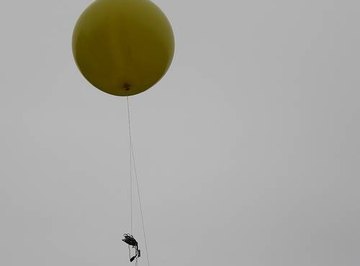
The basic concept of the weather balloon has changed little since its development in the late 1800s, although improvements to the balloon material and data collection have occurred over the years. Surprisingly, with all of today's advanced technology, weather balloons are very similar to those that first lifted off the ground and they still gather the weather data we depend on daily. Today's weather balloons rely on the same principles as their predecessors. A weather balloon today, as it has since its conception, uses gas to lift a data gathering device to a high altitude, where it either remains to transmit data, begins to descend, or bursts and releases its device to float to Earth on a parachute.
History
The first weather balloons came into existence in France in 1892. Devices aboard measured barometric pressure, temperature and humidity but had to be retrieved in order to collect the data. These large balloons inflated with gas and remained open at the bottom like a hot-air balloon. When the temperature cooled in the evening, the gasses cooled and then the balloon deflated and descended. However, no control over the balloon descending back to Earth existed. Sometimes they would drift hundreds of miles, making data gathering difficult.
Types
Within a very short time, a development in the balloon material improved data gathering capabilities. A closed rubber balloon, inflated with a gas that caused it to rise and expand 30 to 200 times its original size and then burst at a high altitude was developed. The attached data-gathering device then dropped from the balloon, fastened to a small parachute. This limited the amount of drift from the launch site making it easier to find the data gathering instruments. This balloon concept still helps meteorologists today, however an attached radiosonde improves data gathering.
Significance
A data gathering and transmitting device that was developed in the 1930s vastly improved the data gathering capabilities of weather balloons. Radiosondes containing sensors that detect air pressure, humidity and temperature as well as a radio transmitter for sending the data back to meteorologists were developed. During ascent, it transmits data to meteorologists. After the balloon reaches its maximum altitude and bursts, the radiosonde, attached to a parachute, descends back to Earth. The parachute slows its descent and prevents harm to persons or property. Radiosondes attached to weather balloons are still in use today and approximately 900 climb into the atmosphere daily while transmitting their data back to Earth every two seconds .
Features
Another development in 1958 allowed meteorologists to send semi-permanent balloons to a designated height and leave them there to gather data over a period of time. Zero-pressure balloons and later super-pressure mylar balloons, invented by a research branch of the Air Force, could reach greater altitude, and based on the gas inside, be calculated to remain at that altitude for a period of weeks or months, where they record and transmit data. These could also be launched over water, which increased the amount of data that could be collected. These balloons transmitted data to satellites.
Considerations
Today both semi-permanent, super-pressure mylar balloons and closed rubber balloons that burst at a high altitude remain in use. Currently, approximately 900 rubber balloons with attached radiosondes similar to those used since 1958 ascend Earth's atmosphere twice per day, throughout the year, delivering vital weather data to forecasters around the globe. Flights last up to two hours and ascend to 20 miles high. All 900 radiosondes transmit data back to meteorologists every couple of seconds for their entire journey.
About the Author
Elizabeth Stover, an 18 year veteran teacher and author, has a Bachelor of Science in psychology from the University of Maryland with a minor in sociology/writing. Stover earned a masters degree in education curriculum and instruction from the University of Texas, Arlington and continues to work on a masters in Educational Leadership from University of North Texas. Stover was published by Creative Teaching Press with the books "Science Tub Topics" and "Math Tub Topics."
Photo Credits
http://www.flickr.com/photos/dan4th/2497579031