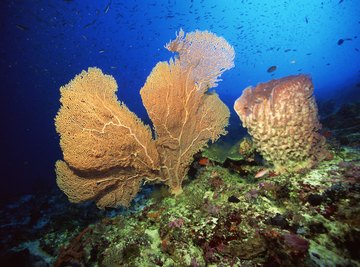
Sponges are animals that belong to the phylum Porifera, which means "pore-bearing." Sponges breathe by moving water through pores, called ostia, which cover their body. Sponges respire through a process called diffusion. Simple diffusion is where chemicals, like oxygen and carbon dioxide, naturally move from areas of high concentration to areas of low concentration.
Types of Sponges
There are two main types of sponges: encrusting sponges grow over the surface of rocks, like moss on a tree; free-standing sponges grow up into the water column. The largest known sponge was found in 2015 in Papahānaumokuākea Marine National Monument - located in the northwestern region of the Hawaiian Archipelago - at a depth of 7,000 feet. This sponge was 12 feet long and seven feet wide, similar in size to a minivan.
Structure of a Sponge
Regardless of which type of sponge you're talking about, they all have the same basic body plan. A sponge's anatomy includes ostia, outer pores where water comes in, a body cavity called an atrium and larger holes where water exists called the osculum. A skeletal structure supports the sponge's body; this structure is usually made up of either silica or calcium carbonate.
Sponges don't have what we would consider organs – just different types of specialized cells that perform all their bodily functions. The unique thing about sponge cells is that the majority of these cells can change their functions as needed.
Collar cells, also called choanocytes, have unique whip-like structures termed flagella, which create currents to move water around the sponge's body. Phagocytic cells filter the water by engulfing it and digesting any food particles they encounter. Other cells form the external skin or create tubes for allowing water to come in. The primary purpose of some cells is to excrete the minerals that form the fibers and spicules which build the skeleton.
As new water is drawn into the sponge's body through the ostia by the flagellating collar cells, it moves through a series of channels and then passes through a filter chamber. Always moving in one direction, the water passes into the atrium and out the osculum. Sponges rely on this continual water flow to gain nutrients and oxygen and remove waste.
Sponges Respire Through Diffusion
Sponges do not have complex digestive, circulatory or respiratory systems to move nutrients and oxygen around their bodies. Rather, each cell is independent and performs its own oxygen, food and waste processes using diffusion. When sponges pump water into their body, nutrient and oxygen-rich water passes over the cells.
Oxygen diffuses into the cells while waste products such as carbon dioxide leave the cells. This process occurs passively because the water moving over the cells has a higher oxygen concentration than the area within the cells. This works in reverse as well – the chemical concentrations of carbon dioxide are higher inside the cells than in the fresh water moving past, so the carbon dioxide flows out of the cell.
How Sponges Use Water Currents
Adult sponges are sessile, which means they do not move; therefore, in addition to actively beating flagella, sponges get assistance from natural water currents to move new water into their body. Typically, sponges prefer to live in areas with strong water currents.
Sponges can control how much water enters their body by opening and closing their pores. Within any 24-hour period, the volume of water a sponge is able to move through its body is up to 20,000 times the volume of the sponge body itself. Many sponge species are so efficient at filtering that they can remove up to 90 percent of the bacteria in the water.
References
- Papahanaumokuakea Marine National Monument: Largest Known Sponge in the World Discovered in PMNM
- Tree of Life: Scientific Observation and Analysis of the Sponges (Porifera)
- University of California Museum of Paleontology: Porifera: Life History and Ecology
- Marine Education Society of Australasia: Porifera - Structure of Sponges
- The Biology Classroom: Phylum Porifera - The Sponges
- Tree of Life: All About Sponges
- Queensland Museum: Structure of Sponges
About the Author
Adrianne Elizabeth is a freelance writer and editor. She has a Bachelor of Science in Ecology and Biodiversity, and Marine Biology from Victoria University of Wellington in New Zealand. Driven by her love and fascination with all animals behavior and care, she also gained a Certificate in Captive Wild Animal Management from UNITEC in Auckland, New Zealand, with work experience at Wellington Zoo. Before becoming a freelance writer, Adrianne worked for many years as a Marine Aquaculture Research Technician with Plant & Food Research in New Zealand. Now Adrianne's freelance writing career focuses on helping people achieve happier, healthier lives by using scientifically proven health and wellness techniques. Adrianne is also focused on helping people better understand ecosystem functions, their importance, and how we can each help to look after them.
Photo Credits
Comstock Images/Stockbyte/Getty Images