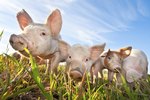
After a sow becomes pregnant, she gestates for approximately three months, three weeks and three days before giving birth to a litter of piglets. After each embryo's placenta attaches to the uterus around day 21, the embryo cells begin to divide and differentiate into tissues and organs. Organs are formed by the time the embryo is 35 days.
Breeding Pigs
A sow may be bred when she comes into heat after weaning her last litter of piglets. If she does not become pregnant after the first breeding, you can breed her a second time when she comes into heat again. Sows enter their second heat approximately 21 days after the first heat. If she does not show signs of heat after three weeks, she is pregnant.
The First 21 Days
During the first one to two days after breeding, embryos migrate to the uterus to begin development. The embryo begins as a single cell, or zygote. It then divides until the embryo is a ball of cells. These cells differentiate into inner and outer cells. The outer cells become the outer membrane of the embryo and part of the placenta, and the inner cells develop into the fetus. At this stage, the ball of cells is called a blastocyte.
Between 12 and 20 days into gestation, the placentas develop and attach to the uterus.
In the first three weeks of gestation after breeding, don't give sows high amounts of feed, as this may decrease embryo survival chances.
Organ Development
After the placenta attaches, the embryonic cells continue to divide and the embryo begins to increase in size. The cells differentiate into three layers:
- The ectoderm layer becomes the cells in the external tissues, nervous system and mammary glands.
- The mesoderm becomes structural tissues, muscles, the reproductive system and these circulatory system.
- The endoderm layer becomes the internal organs, including the digestive system and liver.
The organ system of the fetal pig develops in a manner similar to that of a human embryo. By day 35, the tissues have completed differentiating, and organs are formed.
Primary muscle fiber development continues through day 50. Embryos in the uterus compete for nutrition necessary for muscle growth. Embryos that do not get sufficient nutrition become runts with less muscle mass than the other piglets in the litter.
A sow's nutrition affects the development of the embryos, especially muscle fiber development. After the first 21 days of gestation, increase the sow's feed based on her body condition. A sow is at her ideal weight when you can feel her hips and backbone only with firm pressure.
After the cells have differentiated and organs have formed, the embryo is generally considered a fetus.
The Final Stage
Starting around day 90, embryos quickly gain weight. Increase the sow's feed again at this point so she can maintain her weight and meet the nutritional needs of the fetuses.
Facilitating Farrowing
Within about 24 hours of when the sow will give birth, or farrow, she will become restless. She should have plenty of straw bedding to nest in. If you squeeze her teats, milk should be present. When the sow is within one hour of farrowing, bloody fluid may pass from her vagina.
Once the first piglet is born, farrowing should be complete within two to three hours, a piglet born every 15 to 20 minutes. If the sow shows signs of problems, such as long periods between delivering piglets, straining without the appearance of a piglet, or exhaustion, she may need help. While experienced handlers can insert a hand into the birthing canal to help deliver piglets, you should contact a veterinarian if your sow develops problems.
References
Writer Bio
Maureen Malone started writing in 2008. She writes articles for business promotion and informational articles on various websites. Malone has a Bachelor of Science in technical management with an emphasis in biology from DeVry University.