

How Do Sponges Absorb Water?
A sponge is a common tool used in baths, household cleaning, car washing and other cleaning and soaking activities. Sponges are known for their exceptional ability to absorb water, and are designed after a natural creature of the sea, from which they also derive their name.
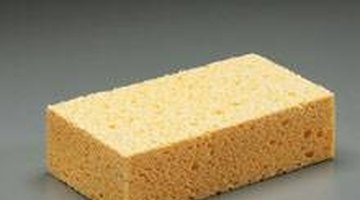
Overview of the Sponge
Sometimes the skeletons of these creatures are actually used as tools by humans, although this practice has gone out of fashion due to the accessibility, low cost and efficiency of modern artificial sponges. For the most part, these artificial sponges are made from cellulose wood fibers--or, in some cases, plastic polymers.
How a Sponge Absorbs Water
The makeup of the sponge makes it is so effective at soaking up water and other liquids. Loose fibers in the sponge create a product that is more empty space than anything else. It is because of this empty space that the sponge can work so well. The holes between the fibers soak up the water and cause the fibrous material itself to swell. This prevents the water from sloshing right back out of the sponge. Instead, the water is trapped inside until the sponge is forcibly squeezed. If you were to remove all of the empty space in a sponge, you would see that the actual matter inside this product would take up less than 1/3 of the sponge's actual size.
Why a Wet Sponge Works Better
Due to the properties of water itself, a wet sponge is often more effective at retaining water than a dry one. You may have observed this phenomenon at work and wondered how it could be. It should be noted that water itself is very sticky. We don't think of it in this way, because it's not sticky like honey or glue, but it tends to stay on a surface. This is why we have to dry ourselves with an absorbent towel after getting out of the shower. Were it not for water's sticky properties, we would we dry in seconds without toweling off. Water sticks to nothing, however, as well as more water. Water molecules are highly attracted to one another. So when you place a wet sponge against a wet surface, the water will jump to bind with the water that is already in the sponge, increasing the sponge's soaking abilities.
Writer Bio
This article was written by the CareerTrend team, copy edited and fact checked through a multi-point auditing system, in efforts to ensure our readers only receive the best information. To submit your questions or ideas, or to simply learn more about CareerTrend, contact us [here](http://careertrend.com/about-us).
More Articles

