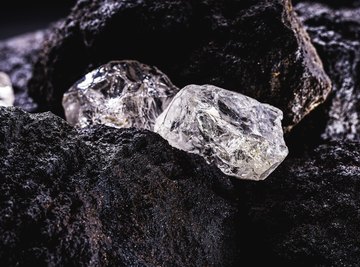

With their glittery brilliance and eye-catching sparkle, diamonds have certainly earned their reputation as a girl's best friend. But what exactly is a diamond? What element is diamond made up of and how is it created? There's much more than meets the eye when it comes to these valuable stones.
What Are Diamonds Made Of?
Diamond crystal is formed entirely out of carbon molecules under specific conditions. This rare form of crystallized carbon can take millions or even billions of years to form in a natural setting. Under the right conditions, each carbon atom bonds to four other carbon atoms, creating an incredibly strong covalent bond. This is where the diamond gets its notoriously strong structure from.
Over time, these carbon atoms begin forming bonds and the crystallized structure grows. The more atoms in the area, the more bonds form and the larger the diamond grows. A single carat diamond contains billions of individual carbon atoms.
How Do Diamonds Form?
So what are the perfect conditions required to create a diamond? Could you take some carbon and create diamonds yourself? Not quite! This is because naturally formed diamonds require immense amounts of pressure and incredibly high temperatures to crystallize.
First, the carbon molecules must undergo intense heat. We're not talking about the hottest setting on your oven either! It takes temperatures of 2,000 degrees Fahrenheit or more to create diamond crystals. To achieve that, the diamonds must be within the heat of the Earth's mantle.
High amounts of pressure are also necessary to create diamonds. This pressure is only achievable if the diamond is a certain distance beneath the Earth's surface (generally 100 miles or more). Carbon molecules require about 725,000 pounds of pressure to form diamond crystals.
How Do Diamonds Get to Earth's Surface?
If diamonds must form 100 miles beneath the Earth's surface, how exactly do we find them? We certainly can't dig that far down. Instead, those diamonds have to move to the surface where we eventually locate them. It takes a volcanic eruption to transport diamonds from the Earth's mantle to the surface.
However, only deep volcanic eruptions can successfully transport diamonds to the surface. This is because the volcano must be deep enough to dislodge portions of the mantle – those that contain the diamonds – and push them to the surface. Most volcanos are not deep enough to do this, and that is why diamonds are as rare as they are. These types of violent volcanic eruptions have not happened in recent history.
Where Are Diamonds Found?
Because diamonds must be carried to the surface through volcanic eruptions, it makes sense that you might find them near areas that have historically had volcanic activity. More specifically, most diamonds occur in formations known as kimberlites. These kimberlites are rock tunnels made up of ancient molten rock that cooled after a volcanic eruption.
However, some kimberlites receive exposure to the elements, such as ones found near rivers or streams. The water slowly weathers away the rock, eventually revealing and washing the diamond downstream. Once the water within the river or stream slows enough for the diamonds to settle to the bottom, the diamonds typically collect in the same area. These regions are known as placer deposits.
Natural Diamonds vs. Lab-Grown Alternatives
Natural diamonds might look pretty, but they come with a cost – and one much higher than the price tag attached to them. Mining natural diamonds expends twice as much energy as growing diamonds in a lab and results in less environmental harm. The best part? Lab-grown diamonds are virtually indistinguishable from natural diamonds, and they have the same physical and chemical structure.
References
About the Author
Marina Somma is a freelance writer and animal trainer. She holds a B.A. in Psychology and a B.S. in Marine and Environmental Biology & Policy from Monmouth University. Marina has worked with a number of publications involving animal science, behavior and training, including animals.net, SmallDogsAcademy and more.