Staph Exposure While Pregnant
Exposure to staph infections may be hard for you to avoid, and the prevalence of hard to treat methicillin-resistant staph aureus, or MRSA, makes reducing your risk increasingly important 5. However, even MRSA is treatable during pregnancy. Staph bacteria is prevalent in places such as locker rooms, gyms and hospitals. If you frequent high-risk places, or if a family member has a staph infection, then you may have been exposed.
Minimizing Risk
Meticulous hygiene can reduce your infection risk. Wash your hands frequently, for at least 20 seconds in very warm water with strong soap. Wear rubber gloves when you touch or clean surfaces touched by infected people. Any time infection is suspected, avoid contact with linens, bandages and dishes. Hospitals and nursing homes carry high risk of staph expsoure, but other crowded gatherings also may increase your risk, so plan to wash your hands frequently or carry hand sanitizer. Wear rubber gloves if you must touch infected materials. In addition, use bandages to cover any cuts you may have as a skin infection is easier to treat than one that enters your body through a cut.
- Meticulous hygiene can reduce your infection risk.
- In addition, use bandages to cover any cuts you may have as a skin infection is easier to treat than one that enters your body through a cut.
Danger to the Baby
Scented Lotion While Breastfeeding
Learn More
Fear of taking medications during pregnancy might cause you to consider delaying treatment, especially since staph does not appear to directly harm your unborn baby. However, an untreated staph infection can become dangerous, and sometimes life-threatening, if it enters your bloodstream. Staph can cause pneumonia if it enters your lungs, depriving both you and your baby of needed oxygen. In addition, your baby will be vulnerable to catching your untreated infection after birth.
- Fear of taking medications during pregnancy might cause you to consider delaying treatment, especially since staph does not appear to directly harm your unborn baby.
- Staph can cause pneumonia if it enters your lungs, depriving both you and your baby of needed oxygen.
Staph Infection Symptoms
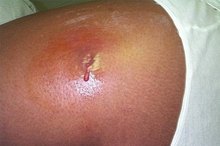
Whether or not you know you have been exposed to staph, see your doctor if you develop an irritated red skin rash, especially one that features puss-filled blisters. Contact with some who is later diagnosed with staph warrants a call to your doctor on what to look for. Watch for a fever accompanying your rash and any instances of family members developing the same rash. Some patients describe MRSA as a spider bite that won't heal. Staph can also cause food poisoning, so report vomiting and diarrhea if you suspect you've been exposed.
- Whether or not you know you have been exposed to staph, see your doctor if you develop an irritated red skin rash, especially one that features puss-filled blisters.
- Staph can also cause food poisoning, so report vomiting and diarrhea if you suspect you've been exposed.
Treatment
Symptoms of an MRSA Infection on the Face
Learn More
Most staph infections are easily treated with antibiotics 5. Treatment usually consists of a course of penicillin, which is considered safe during pregnancy, according to Roger W. Harms, M.D., in an article for MayoClinic.com 25. Resistant strains of staph, called MRSA, are safely treated during pregnancy with stronger antibiotics such as Clindamycin 2. Patients who are allergic to penicillin can also be treated with Clindamycin. Be sure to tell your doctor you are pregnant before starting treatment for a staph infection as some treatments, such as tetracycline, pose significant risks to both you and your unborn child.
Related Articles

Scented Lotion While Breastfeeding
Learn More
Symptoms of an MRSA Infection on the Face
Learn More

What Is the Difference Between Cellulitis & Mrsa?
Learn More
What Is the Difference Between Cellulitis & Mrsa?
Learn More

Metronidazole for a Strep B Infection
Learn More

How to Treat an infected ear piercing
Learn More
What Happens If Ringworm Is Untreated?
Learn More

Garlic vs. Penicillin
Learn More

A Pimple-Like Rash All Over the Body
Learn More
Is Spinal Meningitis Contagious?
Learn More
References
- MayoClinic.com: Is it Safe to Take Antibiotics During Pregnancy?
- Centers for Disease Control and Prevention: Outpatient Management of Skin and Soft Tissue Infections in the Era of Community-associated MRSA
- Vanderbilt Occupational Health Clinic: Exposure to Resistant Bacteria in Pregnancy
- MayoClinic.com: Staph Infections
- Harris A (Updated January 2019). Patient education: Methicillin-resistant Staphylococcus aureus (MRSA) (Beyond the Basics). Lowy FD, ed. UpToDate. Waltham, MA: UpToDate.
- King JM, Kulhankova K, Stach CS, Vu BG, Salgado-pabón W. Phenotypes and Virulence among Staphylococcus aureus. USA100, USA200, USA300, USA400, and USA600 Clonal Lineages. mSphere. 2016;1(3). doi:10.1128/CMR.00134-14
- Cleveland Clinic. (September 2019). Staph Infection (Staphylococcus Infection)
- Tong SY, Davis JS, Eichenberger E, Holland TL, Fowler VG Jr. Staphylococcus aureus infections: epidemiology, pathophysiology, clinical manifestations, and management. Clin Microbiol Rev. 2015 Jul;28(3):603-61. doi:10.1128/CMR.00134-14
- Sukumaran V, Senanayake S. Bacterial skin and soft tissue infections. Aust Prescr. 2016;39(5):159-163. doi:10.18773/austprescr.2016.058
- Bush L. (Modified June 2019). Merck Manual Consumer Version. Staphylococcus aureus Infections. (Staph Infections)
- De oliveira TH, Amorin AT, Rezende IS, et al. Sepsis induced by Staphylococcus aureus: participation of biomarkers in a murine model. Med Sci Monit. 2015;21:345-55. doi:10.12659/MSM.892528
- Harris A (Updated January 2019). Patient education: Methicillin-resistant Staphylococcus aureus (MRSA) (Beyond the Basics). Lowy FD, ed. Waltham, MA:
- Centers for Disease Control and Prevention. Invasive Methicillin-Resistant Staphylococcus aureus Infections Among Persons Who Inject Drugs. Six Sites, 2005–2016.
- Hassanzadeh P, Hassanzadeh Y, Mardaneh J, Rezai E, Motamedifar M. Isolation of Methicillin-Resistant Staphylococcus aureus (MRSA) from HIV Patients Referring to HIV Referral Center, Shiraz, Iran, 2011-2012. Iran J Med Sci. 2015;40(6):526-30.
- Chu C, Wong MY, Tseng YH, et al. Vascular access infection by Staphylococcus aureus from removed dialysis accesses. Microbiologyopen. 2019;8(8):e00800. doi:10.1002/mbo3.800
- Tong SY, Davis JS, Eichenberger E, Holland TL, Fowler VG Jr. Staphylococcus aureus infections: epidemiology, pathophysiology, clinical manifestations, and management. Clin Microbiol Rev. 2015 Jul;28(3):603-61. doi:10.1128/CMR.00134-14
- Romero-gómez MP, Cendejas-bueno E, García rodriguez J, Mingorance J. Impact of rapid diagnosis of Staphylococcus aureus bacteremia from positive blood cultures on patient management. Eur J Clin Microbiol Infect Dis. 2017;36(12):2469-2473. doi:10.1007/s10096-017-3086-5
- Missiakas DM, Schneewind O. Growth and laboratory maintenance of Staphylococcus aureus. Curr Protoc Microbiol. 2013;Chapter 9:Unit 9C.1. doi: 10.1002/9780471729259.mc09c01s28
- Kobayashi SD, Malachowa N, Deleo FR. Pathogenesis of Staphylococcus aureus abscesses. Am J Pathol. 2015;185(6):1518-27. doi:10.1016/j.ajpath.2014.11.030
- Centers for Disease Control and Prevention. (2019). Deadly Staph Infections Still Threaten the U.S.
- Centers for Disease Control and Prevention. (2011). Staphylococcus aureus in Healthcare Settings.
Resources
Writer Bio
Meredyth Glass has been writing for educational institutions since 1995. She contributes to eHow in the areas of parenting, child development, language and social skill development and the importance of play. She holds a Master of Science in speech, language pathology from California State University, Northridge and a Bachelor of Arts in anthropology from California State University, Northridge.