The Forming of a Tornado
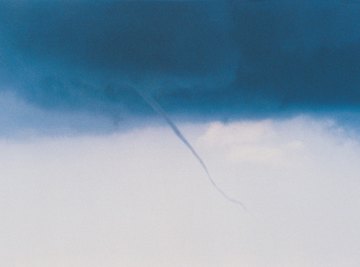
For a tornado to form, two things are needed--a warm, humid air mass, and a cold, dry air mass. Thunderstorms usually contain large swells of warm air. When the warm air moves upward into an area of cold air, instabilities will begin to form. The cap of cold air will eventually give way, causing the storm winds to begin spinning. This will create a funnel shaped cloud. If that funnel cloud touches the ground, it becomes a tornado. A tornado is classified as any rotating column of air which is connected to both a cumiliform cloud and the ground. The average tornado has winds of 110 miles per hour and is about 250 feet across. Most tornadoes travel for a distance of about one mile before dissipating. However, these storms are highly unpredictable and can't be relied upon to conform to average statistics.
The Effects of Tornadoes
The strength of a tornado is measured using a system called the Enhanced Fujita Scale. These violent storms are ranked anywhere from F0 to F5. A tornado must have winds speeds in excess of 200 miles per hour to classify as F5. Eighty percent of tornadoes in the United States are F0 or F1. During an F0 tornado, there is only minor damage. Buildings may suffer broken windows and trees may suffer broken branches or be uprooted is they have very shallow roots. During an F1 tornado, cars may be pushed off the road. Motor homes will suffer severe damage and buildings may experience seriously damaged roofs. Each successive Fujita scale rating denotes higher wind speeds and greater damage from the storms. An F5 tornado is very rare, but will cause almost complete destruction of anything in its path.
When and Where Tornadoes Occur
More tornadoes form in the United States than in any other country in the world. Of these, the majority are found in an area known as Tornado Alley. Though Tornado Alley has no officially designated area, it is usually considered to encompass the plains area between the Rocky and Appalachian mountains. The Midwest region of the United States sees a high concentration of tornadoes as well. Though tornadoes are most common in these areas, they have been reported in every state in the United States. Because tornadoes here are caused by a collision of the warm, moist air from the Gulf of Mexico, and the cold dry air from Canada, the season for tornadoes varies by location. In the plains states, tornadoes are most common in the springtime. The northern states experience the greatest number of tornadoes in the summer, while the southern states tend to experience them in the late fall and winter months. Though the statistics can tell us the most likely time and place for a tornado, there is no real method for predicting these deadly storms. Tornadoes are considered to be especially dangerous because meteorologists are frequently unable to predict their occurrence in time to warn those in the path.
Resources
About the Author
Mandi Rogier is a freelance writer who enjoys writing about a wide range of topics. As a previous employee of Walt Disney World, she enjoys writing travel articles that make use of her extensive knowledge of Orlando theme parks.
Photo Credits
Digital Vision./Digital Vision/Getty Images