The two kinds of living cells have different cell cycles. Prokaryotes are simple organisms whose cells have no nucleus; these cells grow and then split without following a complex cell cycle. Eukaryotic cells have a complex structure with a nucleus and organelles such as mitochondria. In eukaryotic cells, the typical cell cycle is made up of a four-stage cell division process called mitosis (newer sources add a fifth stage) and a three- to four-stage interphase in which the cell spends most of its time.
Cell Cycle Phases Include a Growth Phase and a Division Phase
In both prokaryotic and eukaryotic cells the cell cycle is split between cell division and the period between divisions. Prokaryotic cells grow as long as the required nutrients are available, there is enough room and waste doesn't build up. When they reach a certain size, they split into two.
For eukaryotic cells, cell growth and division depends on many factors. Eukaryotic cells often form part of a multicellular organism, and they can't just grow and divide independently. For them, mitosis and the interphase cell cycle stages are coordinated with the other cells of the organism. Cells differentiate to take on specific roles. Many of these cells spend almost all their time in the interphase, carrying out their specialized functions.
The Stages of Cell Cycle Growth and Fission in Prokaryotes
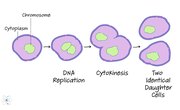
Prokaryotic cells have only two stages in their cell cycle. They are either in the growth stage or, if they are large enough, they enter the fission stage. The survival strategy of many prokaryotes is to multiply rapidly until external limits such as a lack of nutrients are reached. As a result, the fission part of the cell cycle can take place very quickly.
The first step of the fission stage is DNA replication. Prokaryotic cells have a single circular strand of DNA attached to the cell membrane. During fission, a copy of the DNA is made and attached to the cell membrane as well. As the cell elongates in preparation for fission, the two DNA copies are pulled apart to opposite ends of the cell.
New cell membrane material is deposited between the two ends of the cell, and a new wall grows between them. When the new cell wall is complete, two new daughter cells separate and enter the growth stage of their cell cycle. The new cells each have an identical strand of DNA and a share of the other cell material.
Eukaryotic Cell Cycle Timing Depends on the Type of Cell
Like prokaryotic cells, the cells of eukaryotes have to replicate their DNA and divide into two daughter cells. This process is complicated because many strands of DNA have to be copied, and the eukaryotic cell structure has to be duplicated. In addition, specialized cells may reproduce rapidly while others hardly ever divide and still others exit the cell cycle altogether.
Eukaryotic cells divide because the organism is growing, or it is replacing cells that have been lost. For example, young organisms have to grow as a whole, and their cells have to divide. Skin cells continuously die and are shed from the surface of the organism. They have to divide continuously to replace those lost cells. Other cells such as neurons in the brain are highly specialized and don't divide at all. Whether a cell has an active cell cycle depends on its role in the body.
Eukaryotic Cells Spend Most of Their Time in Interphase
Even cells that divide regularly spend most of their time in interphase, preparing to divide. Interphase has the following four stages:
- The first gap stage is called G1. It is the resting phase after the cell has completed division by mitosis and before it starts to prepare for another division.
- From G1, the cell may exit the cell cycle and enter the G0 phase. In G0, cells no longer divide or prepare for division.
- Cells start preparing for division by exiting G1 and entering the synthesis or S stage. The cell's DNA is replicated during the S stage as the first step to engaging in mitosis.
- Once DNA replication is complete, the cell enters the second gap stage, G2. During G2 the correct duplication of the DNA is verified and cell proteins necessary for cell division are produced.
The gap stages separate mitosis from the DNA replication process. This separation is critical for ensuring that only those cells with complete and accurate DNA replication can divide. G1 incorporates checkpoints that verify that the cell has divided successfully and that its DNA is properly constituted. G2 has different checkpoints to make sure DNA replication has been successful. DNA integrity is verified, and cell division can be cancelled or postponed.
The Process of Eukaryotic Cell Division Is Called Mitosis
Once the cell exits interphase and G2, the cell splits during mitosis. At the beginning of mitosis, duplicate copies of the DNA exist, and the cell has produced enough material, proteins, organelles and other structural elements to allow for cell division into two daughter cells. The four stages of mitosis are as follows:
- Prophase. The cell DNA forms pairs of chromosomes, and the nuclear membrane dissolves. The spindle along which the chromosomes will separate starts to form. Newer sources place prometaphase after prophase but before metaphase.
- Metaphase. The formation of the spindle is complete. and the chromosomes line up at the metaphase plate, a plane halfway between the ends of the spindle.
- Anaphase. The chromosomes start to migrate along the spindle, each of the duplicates traveling to opposite ends of the cell as the cell elongates.
- Telophase. The chromosomal migration is complete, and a new nucleus forms for each set. The spindle dissolves, and a new cell membrane forms between the two daughter cells.
Mitosis happens comparatively quickly. The new cells enter the interphase G1 stage. New cells often differentiate at this point and become specialized cells such as liver cells or blood cells. Some cells remain undifferentiated and are the source of more cells that can divide and become specialized. The signals for cell division, differentiation and specialization come from other cells in the organism.
What Can Go Wrong in a Typical Cell Cycle?
The main function of the cell cycle is to produce daughter cells with a genetic code identical to the original cell. This is where the cycle can break down with the most harmful effects, and this is what the checkpoints in the gap stages try to avoid. Daughter cells with defective DNA and therefore a defective genetic code can cause cancer and other diseases. Cells that lack the checkpoints can multiply in an uncontrolled fashion and can create growths and tumors.
When a cell discovers a problem at a checkpoint, it can try to fix the problem or, if it can't, it can trigger cell death or apoptosis. The elaborate cell cycle stages and checkpoints help ensure that only healthy cells with verified DNA can multiply and produce the millions of new cells a normal body produces regularly.
A cell cycle that is not functioning properly quickly leads to defective cells. If these are not caught at a checkpoint, the result can be an organism that can't fulfill normal functions such as looking for food or reproducing. If the defective cells are in a key organ such as the heart or the brain, the death of the organism can result.
References
About the Author
Bert Markgraf is a freelance writer with a strong science and engineering background. He has written for scientific publications such as the HVDC Newsletter and the Energy and Automation Journal. Online he has written extensively on science-related topics in math, physics, chemistry and biology and has been published on sites such as Digital Landing and Reference.com He holds a Bachelor of Science degree from McGill University.