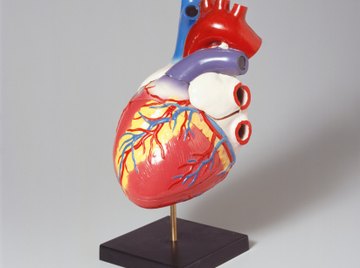

An organ is a structure in the body that has, at minimum, two different kinds of tissues that function together for the same purpose. The kidneys, the heart and even skin are all organs. A human actually has two circulatory systems: a short loop running from the heart to the lungs and back, called the pulmonary system, and the systemic circulatory system, which runs from the heart to every other part of the body and returns.
Heart
The heart is the most notable organ in the circulatory system. This hollow organ is a muscular pump, pushing blood through the body. It beats between 60 and 100 times per minute, typically. During a 70-year lifetime, the heart beats about 2.5 billion times. The heart adjusts its rate depending on how much blood the body needs at a given time. Four chambers make up the human heart: two upper chambers, called the left and right atria, and two lower chambers, called the left and right ventricles.
Blood Vessels
Blood vessels are long tubes that network throughout the body, bringing blood from the heart and back. Arteries carry blood away from the heart and are the thickest blood vessels. The walls contract to keep the blood moving. The walls have three layers, a tough covering, a layer of muscle and stretchy tissue and a smooth lining for blood flow. The aorta is the largest artery, connecting to the heart, then branching off into two main coronary arteries and networks of smaller vessels. The pulmonary artery carries blood lacking oxygen to the lungs, then back to the heart.
Veins
Veins carry blood back to the heart. Veins have valves that keep blood flowing forward. The largest veins include the superior and inferior vena cavae. Tiny capillaries connect arteries and veins, exchanging nutrients and oxygen to cells and removing waste like carbon dioxide. Veins are thinner and less flexible than arteries but do have three wall layers as well. Valves may work improperly, causing blood to pool and form varicose veins, which appear as bumps or jut out from the skin.
Blood
Blood serves as a transport system for oxygen and nutrients and waste materials. Blood that has plenty of oxygen appears red, while blood lacking oxygen looks blue. Blood contains red and white blood cells. Red blood cells contain hemoglobin, an iron-rich substance that carries oxygen and carbon dioxide. A cell typically lives 120 days, so bones constantly create new ones. White blood cells protect the body, devouring bacteria or releasing antibodies to foreign bodies or infections. About 55 percent of blood is made up of plasma, a clear liquid containing platelets that help blood clot.
References
Photo Credits
Photodisc/Photodisc/Getty Images