
Introduction to Crystals
Crystals are beautiful rock formations that have amazed humans for thousands of years. They are used for many different things, not just for decoration. Many of the first radios ever invented used crystals to transmit the radio waves. Some instruments, like quartz watches and laser crystals, use special properties and harmonic capabilities of crystals to make highly accurate measurements and adjustments. Crystals are often viewed as something of immense beauty, and they are commonly used with diamonds or other stones to make pieces of jewelry. The majority of crystals now are man-made in laboratories.
What Are Crystals?
Crystals are nothing more than an ordered arrangement of molecules or atoms. Crystals come in many different shapes and sizes, and each one has different characteristics. What they are made of determines how it will form.
Crystals look unique from many other rocks and minerals, but – barring a few special cases – nearly all minerals hide a crystalline structure underneath the surface. Crystalline structure is characterized by a geometric, repeating pattern of symmetric molecular structure. The arrangement of atoms forms these ordered, repeating patterns.
Crystallography is the study of crystals, and it deals with everything from perfect geometric shapes to seemingly random conglomerations of particles and minerals. Crystals are not only renowned for their physical appearance, but different crystals of different materials and formations can result in a vast variety of uses and physical properties.
Types of Crystals
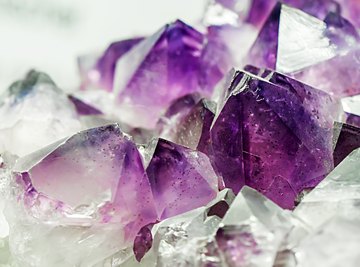
There are many different crystals depending on geometric structures, crystal growth, and material. There can be arrangements of hexagonal carbon atoms or amethyst which makes hexagonal pyramid structures.
Isotropic elements form roughly cubic crystal structures. Mineral crystals like fluorite, gold, and silver all ascribe to this structure. There are many other crystal shapes like tetragonal crystals, monoclinic structures, orthorhombic, trigonal, and triclinic structures. Each of these crystal formations possess different strengths, properties, and embodied energy in their structure.
Some other common forms of mineral crystals that often appear more classically clear or crystal-like in appearance are quartz crystals, salt crystals, gypsum, pyrite, and emeralds (a form of Beryl).
There are other minerals and molecules that can form these crystal lattices. Snowflakes are a classic example of a roughly symmetric and geometrically patterned structure from ice crystals, and gemstones of all varieties are typically crystals. Calcite crystals are often used in optical equipment, and even the graphite in pencil lead are sheets of crystals that essentially break apart layer by layer to write. Silica can form silicate crystals which are the basis for quartz, mica, olivine, and many other crystals and minerals.
Not all crystals are equally crystalline. There are often impurities, and the ionic & covalent between molecules can create vastly different structures out of the same material. A great example of this are diamonds and graphene. These are both solid materials formed from carbon, but the bonds between electrons and carbon in diamonds form a very strong interconnected lattice of molecules, while the graphene crystals are essentially a flat surface that can be just one atom thick.
How Crystals Are Formed
If you want to see how crystals are formed, you can do a little project in your very own kitchen and see the formation of the crystals occur with your own eyes . This can be done by putting a small amount of table salt into some regular tap water, wait 24 hours, and you will see nice cubed formations. This happens because the water is evaporating, which causes the atoms that make up the salt (the mineral) and the water to come closer together. They will eventually make a nice little uniform cluster of atoms, this is the process of growing crystals. The more they can come together, the more of a formation will be visible to the naked eye. Scientists can determine what mineral they are looking at by how the crystals form.
Another fun, and tasty, experiment is to form large crystals using sugar. By heating sugar with water and then letting this solution evaporate on sticks, you can form rock candy from sugar crystals!
Not all crystals form in water, but nearly all crystals form the same way, atoms come together and become a uniformed cluster. The process can take as little as a few days to maybe a thousand years. Natural crystals that come from the Earth form the same way. These crystals were formed over a million years ago inside the Earth's crust. They occur when the liquid in the Earth consolidates and the temperature chills. Other crystals form when the liquid makes its way through the clefts and dispense minerals into the clefts.