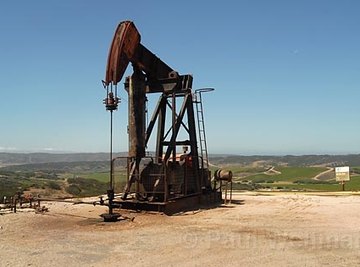

About Oil Derricks
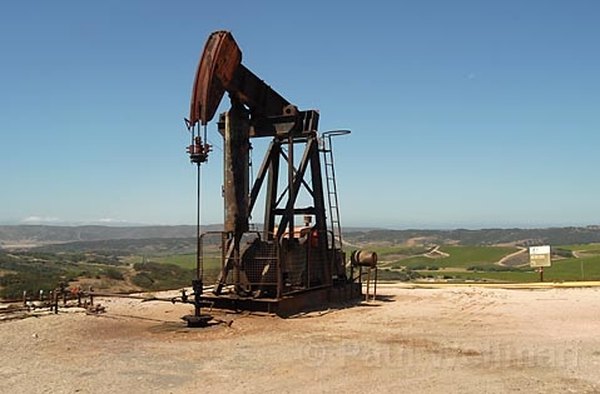
The classic oil derrick pump is known colloquially as a sucker rod pump, named for the plunger-like mechanics it uses to pump oil from underground wells up to the surface. It uses a series of gears and cranks to pump a polished rod up and down an oil well in a piston-like motion, albeit much slower. This design is used to conserve energy while bringing a continuous, reliable flow of oil from deep wells to the surface.
Parts
There are several different parts to the derrick pump. The base attached to the ground is called the power shaft and provides support to the rest of the derrick. Attached to the power shaft are two cranks, each equipped with counterweights that serve to help save energy as the sucker rod is pulled back out from the well. These cranks and their counterweights may be built together as one system. They connect to and move the walking beam, often the longest part of the derrick, propped up by Samson beams and allowed to pivot up and down as drawn by the cranks. At the tip of the walking beam is the horse head, to which the sucker rod is attached, aimed straight down into the well.
Process
The rod operates the oil pump in two stages: one stage occurs in the downstroke of the rod, as it is allowed to fall back into the well, while the other is called the upstroke, when the cranks pull the rod back up higher into the air. There are two plunger-and-ball valves inside the well. On the downstroke, the valve closest to the surface, known as the riding valve, opens and allows oil from the well to flood into the plunger holding chamber, drawn by the pressure of oil caught and sealed by the other pump. On the upstroke, the riding valve is closed but the lower system, known as the standing valve, is opened. This valve draws up new oil by the sudden low pressure environment created by the rising rod. At the same time, the oil caught in the plunger is forced to the surface, where it exits and is collected. The force at which the oil can be expelled from the plunger is what causes the classic "fountain" effect of spurting oil.
There are several variations to this system. The rod may not be directly controlled by the walking beam, for instance, and a second system of cranks may be put into place to more accurately move the plunger system. Different advances in oil drilling and pumping technology have led to various offshoots of the process.
References
About the Author
Tyler Lacoma has worked as a writer and editor for several years after graduating from George Fox University with a degree in business management and writing/literature. He works on business and technology topics for clients such as Obsessable, EBSCO, Drop.io, The TAC Group, Anaxos, Dynamic Page Solutions and others, specializing in ecology, marketing and modern trends.