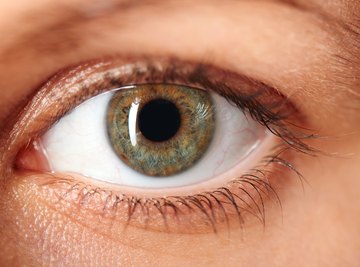

The average person blinks every 4 seconds – that is about 15 times per minute, or over 20,000 times a day, depending on how long the person stays awake. Each blink lasts about a tenth of a second, which isn't a lot of time. But it is enough to clean and lubricate the surface of the eye.
TL;DR (Too Long; Didn't Read)
One blink lasts about a tenth of a second, and an average person can blink over 20,000 times per day.
Blink and Rest
Blinking protects the eyes from bright lights and irritants such as propanethial S-oxide (the tear inducing substance in onions). Scientists have found that blinking also helps the brain get a much-needed break.
Researchers in Japan monitored the brain activity of 10 volunteers using fMRI machines. When they compared the results, the researchers found that participants blinked at the same time when they were watching a TV show. The researchers further tested their hypothesis and discovered that contrary to popular belief, blinking is not a random action but a predictable one. People who are watching a movie or attending a meeting will blink at the same time.
The researchers also discovered that when people blink, areas of the brain associated with wakeful rest activate. It turns out all the fluttering is the brain's way of getting some rest so it can process surrounding information.
Excesive Blinking
Some people blink more than 20 times per minute. Several factors such as problems with the eyelids, ingrown eyelashes, a scratch on the cornea, infections, insufficient tear production or needing glasses can cause excessive blinking. An eye doctor will diagnose the problem and find a treatment, which may include the use of glasses, eye drops or ointments.
A few individuals who are too stressed or bored can develop a blinking tic (voluntary excessive blinking), but that can disappear within a few weeks or months. People also tend to blink more during stressful situations and less when they are concentrating, for example, when reading a book or playing video games.
Not Enough Tears
Dry eye is a condition that affects 30 millions Americans, and it's the number one reason people see an ophthalmologist. When someone has dry eye, they don't produce enough tears to lubricate and clean the eyeball, which leads to excessive blinking, itchiness and redness. Over-the-counter artificial tears can ease the arid sensation, but sometimes dry eye means there is an underlying health problem.
People with lupus, rosacea, arthritis and other autoimmune conditions usually have dry eyes. As people age, tear production diminishes and dryness becomes a problem; in fact, most people over the age of 50 need artificial tears to lubricate their eyes.
Mites, microscopic bugs that cling to eyelashes and feed on sebum, also cause dry eye and therefore excessive blinking. Although this sounds like the stuff of nightmares, getting rid of them is easy. Most eye doctors recommend applying warm washcloths over the eyes and massaging the eyelids.
In rare cases, prescription and over-the-counter drugs can cause dry eye. If this is the case, the easiest solution is speaking with the doctor who prescribed the medication so that they can recommend a treatment for dry eye or prescribe a different medication that does not have dry eye as a side effect.
References
About the Author
Gabriella Munoz is a freelance writer based in Melbourne. She was the editor of Science Illustrated Australia. She has written for many international science publications, including Muy Interesante, ScienceAlert and Wonder of Science. Gabriella has been teaching science communication to undergraduate students since 2017.