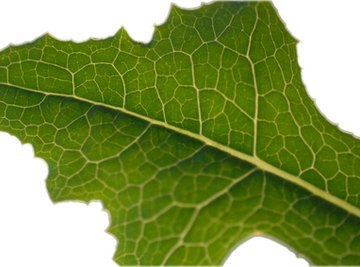

Pigments are colorful chemical compounds that reflect light of a specific wavelength and absorb other wavelengths. Leaves, flowers, coral, and animal skins contain pigments that give them color. Photosynthesis is a process taking place in plants and can be defined as a conversion of light energy to chemical energy. It is a process by which green plants produce carbohydrates from carbon dioxide and water by the help of chlorophyll (green pigment in plants) in the presence of light energy.
Chlorophyll a
Chlorophyll a appears green in color. It absorbs blue and red light and reflects green light. It is the most abundant type of pigment in leaves and thus the most important type of pigment in chloroplast. At a molecular level it has a porphyrin ring that absorbs light energy.
Chlorophyll b
Chlorophyll b is less abundant than chlorophyll a but has ability to absorb a wider wavelength of light energy.
Chlorophyll c
Chlorophyll c is not found in plants but is found in some microorganisms capable of performing photosynthesis.
Carotenoid and Phycobillin
Carotenoid pigments are found in many photosynthetic organisms, as well as in plants. They absorb light between 460 and 550 nm and hence appear orange, red, and yellow. Phycobillin, a water-soluble pigment, is found in chloroplast.
Mechanism of Energy Transfers
The importance of pigment in photosynthesis is that it helps absorb the energy from light. The free electrons at the molecular level in the chemical structure of these photosynthetic pigments revolve at certain energy levels. When light energy (photons of light) falls on these pigments, the electrons absorb this energy and jump to the next energy level. They cannot continue to stay in that energy level, as it is not the state of stability for these electrons, so they must dissipate this energy and come back to their stable energy level. During photosynthesis these high-energy electrons transfer their energy to other molecules, or these electrons themselves get transferred to other molecules. Hence, they release the energy they had captured from light. This energy is then used by other molecules to form sugar and other nutrients by using carbon dioxide and water.
Facts
In an ideal situation the pigments must be capable of absorbing light energy of the entire wavelength, so that the maximum energy can be absorbed. To do so, they should appear black, but chlorophylls are actually green or brown in color and absorb light wavelengths in the visible spectrum. If the pigment starts absorbing wavelength away from the visible light spectrum, such as ultraviolet or infrared rays, the free electrons may gain so much energy that they will either get knocked off their orbit or may soon dissipate energy in the form of heat, thus damaging the pigment molecules. So it is the visible wavelength energy absorbing capability of pigment that is important for photosynthesis to take place.
References
About the Author
Deyanda Flint has been writing professionally since 2001. Her articles have appeared in “Spigot Science Magazine”. She holds a Master of Arts degree in creative writing from Georgia State University.
Photo Credits
chlorophylle image by razorconcept from Fotolia.com