Why Do Megaphones Make Sound Louder?

  1. Sound Is Really Vibration of Air

    • Sound is no more than vibrations of air that can be decoded by the human auditory system. When an individual speaks, air flows from the lungs, across the vocal chords, and out through the mouth; movements of the tongue and lips help articulate specific sounds. As the air passes over the vocal chords and the tongue, the vibrations of these body parts generate the individual's voice. The vibrations travel through the air until they are received by another person or a group of people. When the vibrations arrive at the listener, they cause the sensitive membrane of the listener's ear to vibrate. Sensitive nerves within the ear carry these vibrations to the brain where they are decoded into sound.

    Sounds Tend to Disperse

    • When an individual speaks, or even yells, the air vibrations exiting the mouth scatter in a broad range of directions. Under normal circumstances, this scattering of air vibration is helpful because it allows listeners to hear the speaker no matter where they are in proximity to the individual's mouth. In noisy environments or over great distances, though, the scattering of sound causes the speaker's voice to rapidly dissipate; likewise, the concentration of people in crowded venues allows the air vibrations to be absorbed by bodies, clothing, and personal effects like handbags. For this reason, a speaker on one side of a crowded auditorium is unlikely to be heard very well by someone on the other side, as the vibrations of the speaker's voice are both scattered and quickly absorbed by other individuals closer to the source of the sound.

    Megaphone Concentrates Sound

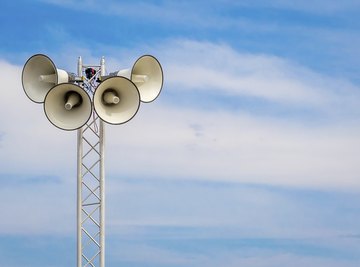
    • When a speaker speaks into a megaphone, however, the conical shape of the device captures the air vibrations and prevents them from scattering. As the vibrations travel through the megaphone, they are protected from interference by other sound sources (such as other people talking or yelling). The sounds exit the megaphone as a tightly packed, concentrated collection of air vibrations that are able to be travel greater distances without being dispersed or absorbed by nearby items. While a listener who is standing or sitting beside someone using a megaphone may not hear the speaker as clearly as if he were not using the device, someone in the path of the megaphone's projection, that is, someone who receives the concentrated collection of air vibrations, interprets the sound as much louder than if the megaphone were not used.

    Megaphones May Be High or Low Tech

    • The traditional image of a megaphone is a cone-shaped plastic device with or without a handle. While this image represents the classic megaphone, other types of megaphones are also readily available. Some high-tech megaphones allow a user to speak into a microphone; the system picks up the user's voice as sound waves, converts them to electronic signals, and plays them through a powerful, amplified speaker; the speaker then uses the acoustic amplification of traditional megaphones to further boost the sound before sending the vibrations out to an audience. On the opposite end of the spectrum, a decidedly low-tech approach to voice amplification is to simply cup an individual's hands around the mouth when speaking. This process catches the air vibrations as they exit the speaker's mouth, preventing them from instantly scattering. While the cupping of hands may not give as much of a boost to a voice as a traditional megaphone, it is a simple and free way to quickly project a speaker's voice when needed.

Related Searches:

References

Comments

You May Also Like

  • How to Buy a Megaphone

    When you're in a crowd and need the attention of the masses, a megaphone can be a great way to amplify and...

  • How to Amplify Sound

    The easiest way to amplify sound is to simply plug a microphone into an amplifier. If you don't happen to have electronic...

  • How to Make a Homemade Megaphone

    A megaphone is very simple to make, as it is essentially a cone. The shape of the cone is what projects and...

  • How to Paint a Cheerleading Megaphone

    Painting a cheerleading megaphone is not a difficult task, but it requires patience and preparation. Cheerleading megaphones can be painted in just...

  • How to Make a Megaphone From Poster Board

    Having your kids do scientific experiments is not only a fun way to kill a couple of hours of an afternoon, but...

  • Facts on Megaphones

    When large crowds gather and a message must be delivered, there is one traditional tool for amplifying a human voice that dates...

  • How to Make a Megaphone Motorcycle Exhaust

    Megaphone exhausts have enjoyed a high degree of popularity with motorcyclists for decades. Producing a deep tone and a free-flowing path for...

  • The History of the Megaphone

    Megaphones, also called bullhorns, speaking trumpets and loud hailers, are devices used to amplify the human voice. They are instantly recognizable by...

  • How to Decorate a Megaphone Cutout

    Megaphones are common symbols associated with cheerleading. A megaphone cutout may serve as a party decoration for a sports-themed event, a prop...

  • How to Make a Megaphone Cake

    Megaphones have been used at sporting events since the 1880s -- the first known occasion of this was a football game at...

  • How to Make Your Car Sound Louder

    There are many ways to give your car a deeper, meaner sound, and most of those involve modifying the exhaust system. Generally,...

  • Dobro Guitar Troubleshooting Information

    Resonator guitars have many of the same repair issues as other guitars--poor action, inadequate sound, neck and tailpiece issue--but they have a...

  • How to Make a Grandfather Clock Chime Louder

    You can make a grandfather clock chime louder by adjusting the chime hammers. If the hammers are not set correctly, they may...

  • How to Use Megaphones

    A megaphone, also known as a bullhorn or speaking trumpet, allows a person to project their voice over a large crowd. The...

  • How to Use a Computer as an Amplifier

    In the past, a hi-fi system usually consisted of a CD player, tape deck and turntable. However, none of these devices worked...

  • How to Design a Church's Acoustic Treatment

    The key to designing optimum acoustics in a church is the selection of sound-absorbent paneling. Since churches can be large and cavernous,...

  • How to Amplify Speaker Sound

    Speakers are devices that translate signals from an electronic device, such as a receiver or CD player, into audible sound waves. Occasionally...

Related Ads

Featured