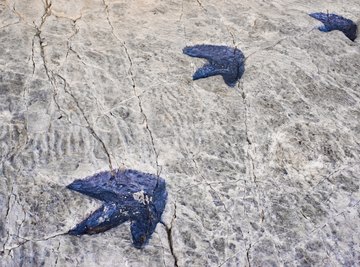
An imprint fossil, also known as an impression fossil or fossilized impression, is a fossil that doesn't contain organic material. They are a form of trace fossil – a fossil that leaves evidence of an organism's movements or activity. Examples of trace fossils include footprints, eggshells, nests and more.
Imprint or impression fossils occur exactly how you might imagine. An organism creates an impression into a soft surface. If that surface eventually hardens, and that imprint becomes a fossil.
Where Does an Impression Fossil Form?
For an impression fossil to form, the conditions have to be just right. The type of ground dictates if an impression fossil remains or fades away. Most impression fossils form in sediments with very fine grains, such as clay or silt.
Think of it this way: If you take a step in sand, a large-grain sediment, your footstep almost instantly collapses in on itself and eventually blows away. However, if you take a step in thick clay, you probably have to pull your foot out with some difficulty, leaving behind an almost perfect imprint of your foot.
How to Create Your Own Impression Fossil
Things You'll Need
- Modeling clay
- A "model" to imprint, such as a leaf or shell
- A variety of different leaves or vines (ferns make a great imprint)
- Small sticks or branches
- Snail shells or seashells
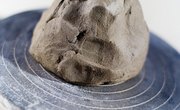
To create your own (albeit sped-up) impression fossil, you'll need a flat surface to press your object into. Roll your clay into a ball and carefully press it down onto a flat surface such as a paper plate. You want to flatten your clay until you have an even surface about half an inch thick.
You'll want to find the most interesting object you can to create your imprint. You can create an imprint with your own hand or your dog's paw, or you can use an object from nature. Some examples of things you might be able to create imprints with that you could find in your backyard or at the park include:
Carefully take your object and press it gently but firmly into the clay. You don't want to press so far that you break through the other side of the clay, but you do want to ensure that the object creates an impression on the surface of the clay.
Thinner objects, such as leaves and small sticks, only need gentle, even pressure to transmit their pattern onto the clay. Larger objects, such as seashells, might need more pressure if you want a full impression. If you plan on using seashells or larger objects for your impression, you might even leave your clay base a bit thicker to account for the size of your imprint.
Natural impression fossils require many years to dry out and harden. Thankfully, you don't have to wait that long! Have a parent or other adult help you bake your modeling clay so that it hardens in a timely fashion. They should use the directions on the box to determine the temperature to bake the clay at and the amount of time required for the clay to fully cure.
Once it has baked and cooled, you can also paint your impression fossil if you so choose.
Impression fossils help scientists better understand the creatures that lived in other times. Footprints can show them more about the movements and activity of dinosaurs, and imprints of leaves can tell them more about the plant life that might not otherwise have been preserved.
References
About the Author
Marina Somma is a freelance writer and animal trainer. She holds a B.A. in Psychology and a B.S. in Marine and Environmental Biology & Policy from Monmouth University. Marina has worked with a number of publications involving animal science, behavior and training, including animals.net, SmallDogsAcademy and more.
Photo Credits
Jultud/iStock/Getty Images