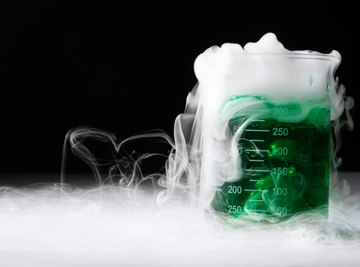
Placing dry ice into water, such as fruit punch, to simulate a boiling cauldron of witch’s brew is a favorite Halloween party trick. Science teachers commonly use this effect to demonstrate the principles of sublimation and condensation.
Dry Ice
“Dry ice” is actually solidified carbon dioxide (CO?). Carbon dioxide is normally a gas at room temperature and pressure. When it is put under high pressure at low temperature, however, it solidifies into what is commonly called “dry ice.” When the dry ice is brought to atmospheric pressure, it remains solid and very cold (-109 °F).
Sublimation
Dry ice is called “dry” because it never enters a liquid state as it melts, unlike ice, which melts into liquid water. Dry ice transforms directly to gaseous carbon dioxide. Scientists refer to this process as “sublimation.”
Water
The water does not play a critical role in this process other than containing a substantial amount of heat that is transferred to the dry ice to sublimate it. Many other liquids could be used in place of water, but water is particularly good at retaining heat (in scientific terms, water has a high specific heat capacity).
Condensation
When a liquid such as water turns into vapor, the process is called evaporation. The reverse process is called condensation. At low temperatures, water will condense out of the air into very small droplets of water.
Clouds
Clouds are actually very small droplets of water (or possibly even ice crystals) that have condensed in the low temperatures of the upper atmosphere. The “witches brew” effect produced by dry ice in water represents the same phenomenon on a smaller scale. As the carbon dioxide sublimes, the gas-phase carbon dioxide is still quite cold. Water in the air condenses in the cold carbon dioxide gas as it rises above the water.
Fun Fact
The long tails of comets are the result of carbon dioxide and other ices sublimating as the comet passes close to the sun.
Photo Credits
Jupiterimages/Photos.com/Getty Images