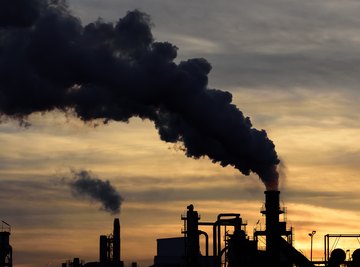

The term "fossil fuels" has evolved from a cheeky moniker into a something of villain in the public consciousness. Formerly a benign enough name to the substances that perhaps single-handedly propelled global civilization into a truly modern age, many people now associate "fossil fuels" with pollution – not merely ugly smoke and noxious vehicle exhaust, but the sort of materials with the capacity to veritably ruin or end civilization, depending on whom one listens to.
As of 2018, the U.S. derived 81 percent of its energy from fossil fuels. These are not renewable, and as the world's population increases and the supply of fossil fuels dwindles, it becomes more expensive to extract what fossil fuels remain from their subterranean sources. Moreover, the burning of fossil fuels, more than just a blight on skylines, creates products that contribute to global warming, which scientists around the planet agree is an extremely urgent issue political entities would be reckless to ignore.
What Is the Process of Burning Fossil Fuels?
Fossils fuels include oil (i.e., petroleum), coal and natural gas. One of these is a thick liquid, another a solid and the third a less dense liquid, but they all share a common origin. As the name implies, these fuels arise from material that was once a part of living things, both animals and plants, in the very distant past. These prehistoric organisms were compressed over a period of millions of years by rocks, but only when temperature and pressure conditions favored the process; that is, only a small fraction of ancient life was converted to fossil fuels today, just as only a small number of prehistoric animals and plants resulted in the formation of fossils that gave today's human paleontologists specific clues about what these organisms, from dinosaurs to giant ferns, looked like and how they lived.
Oil: This fossil fuel is used mainly for heating and transportation, and it is the source of gasoline in its various forms. It is arguably the single most valuable commodity the world over, and has transformed civilization in a number of obvious and crucial ways.
The U.S. relies heavily on other countries to meet is massive oil demands, and some of these nations are subject to ongoing political upheaval. The U.S. Department of Energy's Office of Petroleum Reserves (OPR) maintains an emergency stash of oil in the event foreign supply is suddenly cut off. This supply, divided into three sources, includes almost three-quarters of a billion barrels of oil.
Coal: This fossil fuel is the largest domestically produced energy source in the U.S. and provides a significant fraction of the electricity supply. In 2015, the U.S. produced over 900 million tons of coal, and about 25 percent of all of the coal reserves in the world are believed to lie within America's borders. Coal is also a very cheap source of energy, pound for pound.
Unfortunately, coal is extremely problematic from the standpoint of pollution. There is also some question of how accessible the vast reserves of coal in the U.S. really are. With the energy economy moving toward renewable sources, all fossil fuels are likely to be de-emphasized in the decades to come, but the coal industry may be especially vulnerable as a result of public pressure as well as basic economic realities.
Natural Gas: As of 2018, the U.S. was the world's leading producer of natural gas. Much of this is owed to the natural gas extracted from shale, a type of sedimentary rock. This kind of natural gas, called shale gas and consisting mainly of methane (CH4), has developed into a subject of intense interest and attendant controversy thanks to recently developed ways to extract it from the ground, allowing for the tapping into considerable reserves that have lain dormant within rock until now. One of these, hydraulic fracturing ("fracking"), has become a target of environmental groups thanks to its potential and observed effects on the rock from which it is removed, including the increased possibility of earthquakes when waste water from fracking is re-injected into the ground.
How Much Coal Is Burned Each Year?
801 million tons of coal were consumed in the U.S. in 2015, almost all of it for the purpose of generating electricity. Based on current projections, this number is expected to gradually decrease to about 557 million tons by 2040, an average decline of about 1.4 percent per year. This is in spite of the fact that the U.S. population is growing (albeit not as quickly as that of developing nations) and the fact that the U.S. is thought to have 257 billion tons of coal in reserve. For reference, a billion is 1,000 million, so the amount of coal remaining underground in America is about 300 times the amount presently being burned annually.
While West Virginia and Pennsylvania receive a lot of attention whenever the subject of U.S. coal mining arises, as of 2018, about 57 percent of the coal mined in the U.S. came out of the ground of states in the western half of the country – 42 percent from the state of Wyoming alone. This is owed to the fact that this "brand" of coal is lower in sulfur content. Regardless, coal burning releases greenhouse gases, not only carbon dioxide (CO2) but also methane (CH4), and its extraction disrupts the natural environment no matter what care is taken to minimize damage to local environments.
What Happens When Humans Burn Fossil Fuels?
Fossil fuel pollution is at the center of one of the most contentious and important national conversations in the U.S., as well as a driving force of political, economic and technological movements all over the world.
All fossil fuels contain large amounts of carbon; if you've followed the energy and climate-change debate at any level, you have likely heard the term "carbon footprint" used to describe the relative amount of fossil fuels being used by a given sector, piece of equipment or community. Fossil fuels also contain substantial amounts of the elements hydrogen, oxygen, nitrogen and sulfur. All of these elements are highly reactive, both with each other and with different elements in the air and on the ground.
The primary pollutants released from the burning of fossil fuels are carbon monoxide (CO), carbon dioxide (CO2), sulfur dioxide (SO2), nitrogen oxides of the chemical form NOx (primarily nitrogen dioxide, or NO2), nitric oxide (N2O), various hydrocarbons (methane, CH4, being one such example) and substances collectively termed volatile organic compounds, or VOC. Some of these are hazardous in their native forms; others are especially damaging only after they combine with other otherwise benign reagents in the atmosphere.
By far the most concerning and talked-about of these compounds is CO2. Because carbon accounts from between 60 to 90 percent of the mass of the fossil fuels burned, CO2 is the principal product of the combustion of fossil fuels worldwide. China has become the largest emitter of CO2 on the planet, with total mass reaching 8.32 billion metric tons in 2010. (A metric ton is 1,000 kilograms, or about 2,200 pounds, making a metric ton about 10 percent more massive than a standard ton.) The U.S., ranked second in this dubious category in 2010 with an output of 5.61 billion metric tons. (China's population as of 2018 was over four times that of the U.S.)
What Are the Consequences of Burning Fossil Fuels?
While CO2 receives the bulk of the attention as a greenhouse gas – meaning a substance that can trap unwanted heat in the Earth's atmosphere and contribute to the increasing average surface and sea temperatures now afflicting the planet and expected to continue unchecked without a serious effort to restructure the entire means of energy delivery the world over – CH4 is actually a more potent greenhouse gas, molecule per molecule, than CO2 is. The effects of CO2 predominate over those of methane simply because there is so much more of it in the atmosphere, even though CO2 accounts for less than 1 percent of the gases in the atmosphere. What makes CH4 particularly troubling is that its its emissions arise not only from the combustion of natural gas, but during drilling operations and also during the transportation of natural gas in pipelines.
Effects on climate represent a small fraction of the harm that burning fossil fuels can produce. In fact, even if there were no effects whatsoever on the planet's temperature of CO2 and CH4 emissions, fossil-fuel combustion would still be problematic. For example, nitrogen oxides can combine with other atmospheric elements to from smog (ground-level ozone) and acid rain. Ammonia (NH4) is also produced during the combustion of fossil fuels. Most nitrogen oxides reach the environment via vehicle emissions. VOC also contribute to the formation of smog. The particulate matter (PM) formed in the atmosphere thanks to fossil-fuel combustion can cause or worsen a variety of chronic lung conditions, such as asthma and bronchitis.
In a nutshell, the burning of any kind of fossil fuel is almost certain to cause something to become warmer, hazier or more acidic, or otherwise take on characteristics that are undesirable to the ecosystem as a whole.
What Would Happen if Resources Disappeared?
As noted, the U.S. alone has a great deal of oil stashed away in reserves and billions of tons of coal underground. Whatever you may have heard about the imminent drying up of oil and natural gas wells is most likely an exaggeration. Instead, it is concerns about the hazards of burning fossil fuels that are motivating energy pioneers and environmental leaders to pursue the many known alternatives to fossil fuels, collectively known as "clean energy." These include solar, wind, hydropower, biofuels and nuclear power; of these, all but nuclear are considered renewable as well as "clean" (nuclear power comes from uranium, which is a finite resource).
In addition to making greater use of these alternative fuels, people can work to make more efficient use of fossil fuels by being conscientious. Businesses, for example, can manage and reduce emissions, increase energy efficiency in the workplace by stricter monitoring of wasteful use of electricity and also look into buying renewable energy. It is also vital, however, for individuals to take part in active energy conservation. Turning off your lights, computers, televisions, video games and other electrical equipment when they are not in use may sound like an old, tired refrain from a nagging parent, but these measures do add up to a vast number of kilowatt-hours saved per year when people are attentive.
Finally, walking or cycling to work whenever possible, or making use of public transportation such as buses and light-rail options (many of which are now using hybrid fuels) is not only beneficial to the environment but also eases the stress of having to drive on congested roads and breathe in others' exhaust.
References
- National Academies of Sciences, Engineering and Medicine: Fossil Fuels
- U.S. Environmental Protection Agency: The Sources and Solutions: Fossil Fuels
- Pennsylvania State University: Energy Conservation and Environmental Protection – Products of Combustion
- Union of Concerned Scientists: The Hidden Costs of Fossil Fuels
About the Author
Kevin Beck holds a bachelor's degree in physics with minors in math and chemistry from the University of Vermont. Formerly with ScienceBlogs.com and the editor of "Run Strong," he has written for Runner's World, Men's Fitness, Competitor, and a variety of other publications. More about Kevin and links to his professional work can be found at www.kemibe.com.