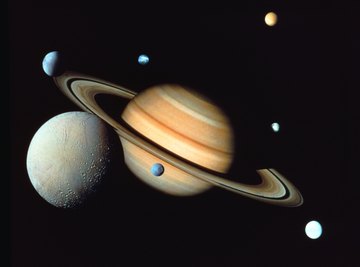
Saturn is an interesting planet that catches the attention of young children due to its unique ring system. These projects will teach kids about the planet Saturn, its rings and what the planet’s atmosphere is like. With basic materials, these projects can be done in the classroom or at home with individual children or a group of kids. The projects do need adult supervision, so make sure to have a grown up help.
Saturn's Rings
Demonstrate how Saturn’s rings are spinning around the planet alongside the planets rotation. Have kids sit on the ground and try to feel the Earth spinning. It takes 24 hours for the Earth to fully rotate, creating day and night. On Saturn, it only takes about 10 hours.
The rings of Saturn are located around the equator of the planet and are made of small bits of space matter such as rocks and ice. The rings are moving around the planet as it rotates.
Use a long length of twine and tie it around a small object that can be tied securely, such as a large wooden bead. The bead represents space matter that is part of Saturn's rings. Have a child hold the end of the twine in one hand and begin spinning in a circle. What happens with the bead? Let each child have a turn.
Saturn's Density
Saturn’s density, or measure of mass, is different than on Earth. Saturn has a lower density than Earth, meaning things would weigh more on Saturn than they do on Earth.
Experiment with density by doing a demonstration that requires adult help.
Boil 1/4 cup of water and have it ready to use. Cut off the top of a small balloon. Use an empty aluminum beverage can for the demonstration. Take the pop top off the aluminum can. Pour the water into the can and cover with the balloon. Secure the balloon with a rubber band, being careful not to get burned.
Observe the changes to the aluminum can. The can changes its outward shape due to the changes in pressure and density within the can, which makes it pull into itself. Would aluminum make a good material for a space ship or space suit when traveling to Saturn?
Saturn Art and Science
Create a model of Saturn using colorful construction paper, scissors, crayons, sand, glitter and glue. Use a black sheet of construction paper as the background and have kids cut a circle out of construction paper to represent Saturn. Saturn doesn't have a surface and is made up of gasses. Use crayons to color areas of gasses on Saturn.
Use glue, sand and glitter to create the rings around Saturn. Create lines around the equator of Saturn with glue and then sprinkle with sand and glitter to create the rings around Saturn.
References
About the Author
Sarah Lipoff has been writing since 2008. She has been published through BabyZone, Parents, Funderstanding and Education.com. Lipoff has worked as a K-12 art teacher, museum educator and preschool teacher. She holds a Bachelor of Science in K-12 art education from St. Cloud State University.
Photo Credits
John Foxx/Stockbyte/Getty Images