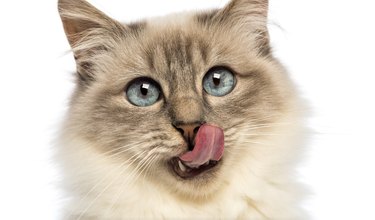
If your cat has been biting at your hair, she may be grooming you, just as she would another cat. Cats clean their own fur with their tongue and teeth, so your feline friend may be styling your hair with hers to show you how much she loves you. Unfortunately, excessive hair biting could indicate a more serious health or behavioral issue, especially if your feline friend is pulling or biting off and ingesting your hair on a regular basis.
To Show Affection
Video of the Day
Cats lick and nibble at each other when they groom as a way to bond and show affection. This type of mutual grooming is known as allogrooming. Typically, allogrooming occurs when a cat grooms another kitty on the head and neck, according to an article in the 2004 edition of the Journal of Feline Medicine and Surgery. Mutual grooming helps cats relieve stress and create a communal scent with other felines. Because your kitty views you as part of her social circle, she may do the same with you.
Video of the Day
She Likes the Taste
Some types of hair products may have a taste that is appealing for your feline friend. Your cat may be lured over to your hair to bite on it because it tastes good to her, according to feline behaviorist Pam Johnson-Bennett, owner of the Cat Behavior Associates practice in Nashville, Tennessee. If you've recently switched to a new hair product that has attracted the attention of your feline friend, you may want to change to another scent or an unscented variety. Kitties generally don't like citrus scents, so opt for orange, lemon or grapefruit if your cat's incessant hair biting is getting on your nerves.
She's Suffering from Pica
Some cats like to eat nonfood items such as hair or fabrics because they suffer from a condition known as pica.
- Pica can be caused by a nutritional deficiency or even a medical problem such as diabetes or feline leukemia, warns WebMD.
- Sometimes cats who are stressed or don't get enough exercise may redirect their energy into biting on your hair instead.
- In some cases, early weaning can lead to pica later in life, according to the American Society for the Prevention of Cruelty to Animals.
- Oriental breeds like the Siamese are more genetically prone to developing pica than others.
Dealing with the Hair Biting
If your cat's hair biting isn't damaging your strands or causing you any discomfort, simply sit back and enjoy your grooming session. Stroke your kitty on her head and neck to return the favor.
To discourage your feline friend from biting at your hair, simply get up if she starts to bite your hair and sit in another spot. Pretty soon, she'll learn that biting your hair won't get her any attention or time with you. You also can redirect her attention onto another activity.