
How to Use a Cam Walker
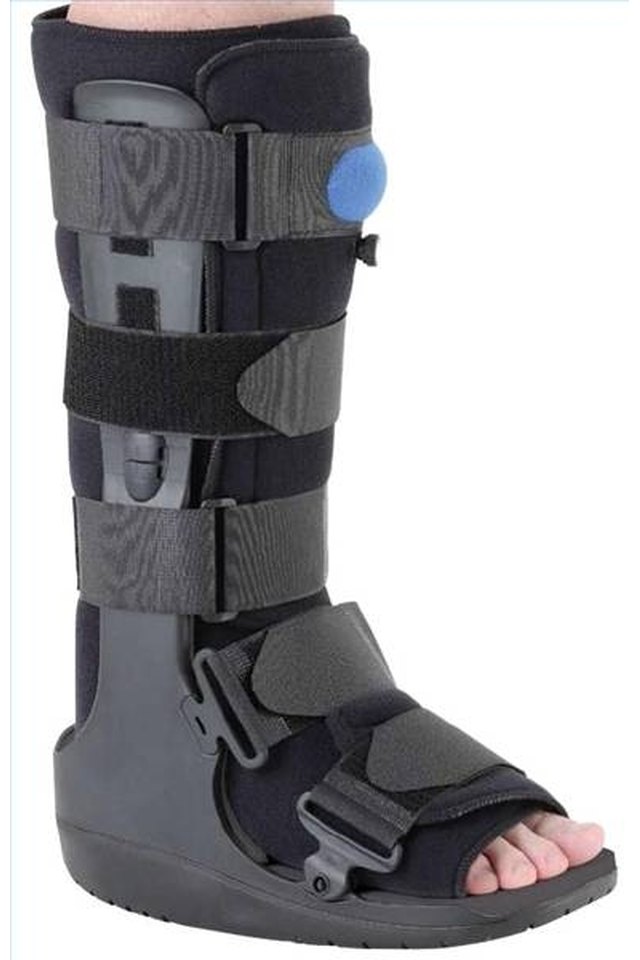
Treatment for ankle fractures and other lower extremity injuries can involve the use of special braces. The "cam walker" design is a lower extremity boot that provides support, protection and immobilization of the ankle after injury or surgery. If you have a prescription for a Cam walker brace, you should have a clear understanding of the type and extent of your problem. These medical devices have been widely used for treatment of sprains, fractures, diabetic ulcers and Achilles tendon injuries/surgeries.
The nature of a specific problem, such as an ankle fracture that may involve weight-bearing restrictions, together with the time frame of healing or rehabilitation (such as 8 to 12 weeks for a fracture versus 4 to 6 weeks for a sprain), determines how the cam walker will be used. In the early phases of a fracture, for example, a cam walker may be used primarily as a "cast" but, unlike a cast, one has the ability to remove it for cleansing the body part as well as ice application. Very little weight-bearing may be allowed until more healing can accommodate increased weight on the extremity.
Apply stocking or proper under wrap. If there is a need for using an ace bandage, now is the time to be sure it is in place. If not, use a tube sock or other white athletic sock. The white color won't stain your skin with perspiration as it could with a colored sock.
Slide foot into the cam walker, making sure the foot rests completely flat down on the brace. Make sure the size is correct. Your toes should not be hanging over the front edge. Similarly, the boot shouldn't be so big that it protrudes significantly beyond your toes, or you risk stubbing your foot or falling.
Secure the foam padding by wrapping it around the foot, ankle and lower leg, starting at the foot. The wrap should be comfortably snug and without wrinkles. Securely attach by using the Velcro edging on the under padding.
Secure the straps on the cam walker by beginning at the foot and working up the leg. The straps should be sung enough to prevent slippage on the boot, but not so tight as to restrict circulation or be uncomfortable.
Ambulation typically begins with putting the "bad" foot forward first. If you are using assistive devices such as crutches, the "bad foot forward" concept works equally well here. Bear weight as prescribed, with or without assistive devices.
Tips
Make sure you have a clean sock or wrap underneath the brace for protection and comfort.
Make sure your heel is always seated completely to the back of the foot portion of the brace for optimal fit.
Warnings
Never tighten straps too tight.
Be sure brace is the correct size.
Make sure toes don't overhang the front of the brace.
Never exceed your prescribed weight-bearing levels unless directed by your doctor.
Tips
- Make sure you have a clean sock or wrap underneath the brace for protection and comfort. Make sure your heel is always seated completely to the back of the foot portion of the brace for optimal fit.
Warnings
- Never tighten straps too tight. Be sure brace is the correct size. Make sure toes don't overhang the front of the brace. Never exceed your prescribed weight-bearing levels unless directed by your doctor.
Writer Bio
Ken Chisholm is a freelance writer who began writing in 2007 for LIVESTRONG.COM. He has experience in health care, surgery, nursing and orthopedics as an orthopedic physician assistant and a registered nurse. He holds a bachelor's degree in business from the University of Findlay, Ohio.