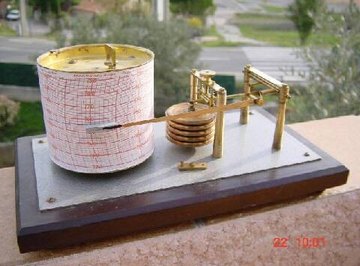

Measuring air pressure is the primary function of the barometer. The National Weather Service describes air pressure as the sum total of pressure exerted as randomly moving individual molecules strike a surface. Pressure is directly related to density, and both decrease with an increase in height. Because of this, for comparison purposes surface barometric pressure readings are all converted to sea-level pressure or the pressure of the air if it were at sea level.
History
Funk and Wagnalls New Encyclopedia credits the Italian Evangelista Torricelli for the invention of the barometer in 1643. He did this while studying the characteristics of mercury in a vacuum, thus the first barometer was of the mercury type. French scientist Lucien Vidie is often cited as inventing the aneroid barometer about 200 years after the mercury variety. Using the tool for weather forecasting came about after the connection between air pressure and weather systems was made.
How They Work
Mercury is used in barometers because it is heavy, making for relatively small changes in height when pressure changes. This means a mercury tube can be of reasonable size. The top of the tube is closed. The open bottom is in a container of mercury and a ruler is alongside the vertical tube. The liquid will rise and fall based on the ambient air pressure. The aneroid measurement tool uses a flexible metal shaped like a spring that is depressurized. It is sealed, allowing it to compress and expand with changes. Connecting this metal to an arm with a pen on the end makes a rising and falling line on a rotating sheet of paper, thus recording changes with time.
Units of Measurement
Meteorologists often use the millibar (mb) as the unit for atmospheric pressure for upper levels and the surface. In the U.S. surface pressure is often reported in inches of mercury (inHg). This comes from the use of mercury barometers; a change of one inch corresponds to a one inch rise or fall in mercury level. Scientists will sometimes use kilopascals (kPa), which are millibars divided by ten. Standard sea level pressure is considered to be 1013.25mb's. This corresponds to 14.69 psi, 29.91 inHg, and 101.325 kPa's.
Function
Measuring air pressure is useful for different weather related purposes. The best known use is predicting weather systems. Rising pressure generally means fair weather, while descending pressure means clouds and possibly precipitation. Heights can also be measured because approximations of pressure levels at certain heights are known. For example, the average height of the level at which pressure is 500 millibars (mb's) is 18,000 feet. Colder air will cause the 500mb level to decrease in height, as pressure increases with colder air. The opposite happens with warmer air. On surface charts lines of equal pressure, or isobars, are drawn to depict high and low systems.
Warning
The Environmental Protection Agency states "Mercury exposure at high levels can harm the brain, heart, kidneys, lungs and immune system of people of all ages." It can also harm other animals. If a mercury barometer is used precautions must be taken, and spills should be cleaned properly.
About the Author
Writing professionally since 2008, Don Shepard has been published in a water resources laboratory manual and in various online publications. He holds a Bachelor of Science in meteorology from Ball State University. His most recent work includes performing editing team leading duties for a prominent political advocacy firm.