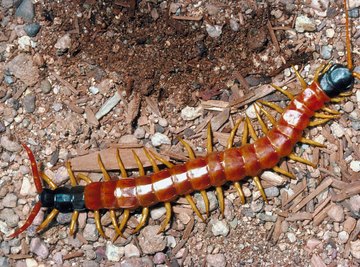

Centipedes belong to the order Arthropoda. They are related to invertebrates such as insects, spiders, scorpions, crabs and lobsters. They have long, segmented bodies with many legs. Their hard, outer covering doesn’t help them retain water, so they must live in damp, moist places to avoid drying out. Centipedes are fierce predators and use speed and claw-like structures to catch their prey. While most centipedes live outside, the house centipede thrives indoors.
TL;DR (Too Long; Didn't Read)
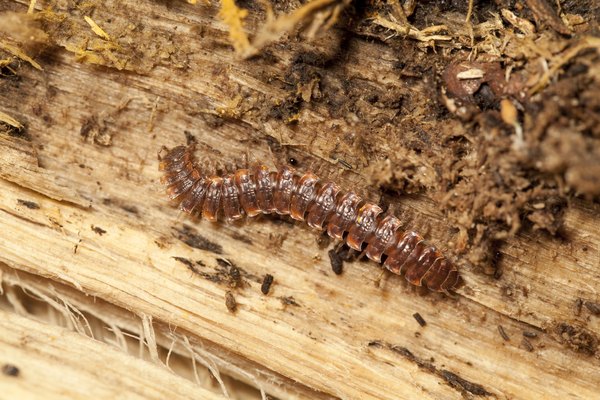
Centipede means "100 foot" in Latin. However, most centipedes have 15 to 30 pairs of legs.
Centipede Anatomy
Centipedes are arthropods, meaning they have a hard exoskeleton and their bodies are divided into segments. They aren’t insects, because centipedes can have many body segments while insects have only three. Each segment has one pair of legs. Although the prefix cent- means 100, the number of legs a centipede has depends on the number of body segments. Centipede legs are attached to the side of the body segments, rather than underneath, which enables them to move quickly.
Where They Live
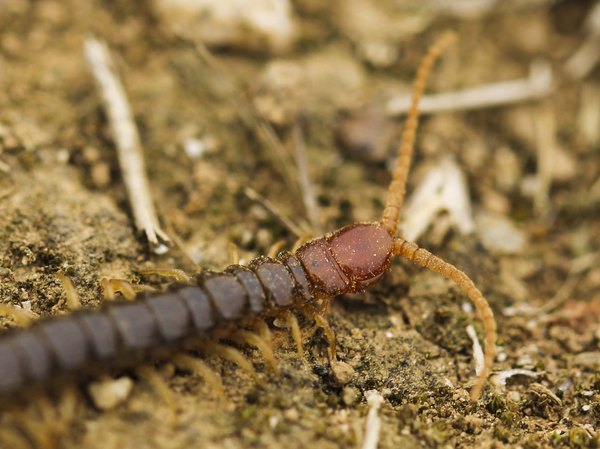
Centipedes are stealthy and mainly prefer to move about under the cover of night or in dark places that do not receive much sunlight. Their preferred habitats include caves and forests. Many types of centipedes also live in deserts. They seek shelter under rocks or fallen trees and in soil and leaf litter. Some species live underground, spending their lives in the soil. The house centipede prefers living in basements and under cabinets in bathrooms where conditions are dark, cool and damp.
Predatory Adaptations
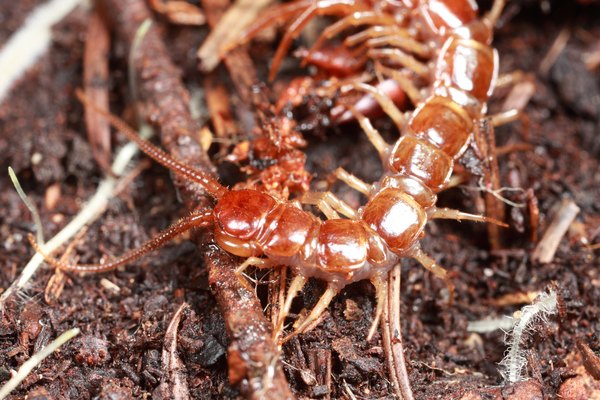
Centipedes are aggressive predators that hunt spiders and insects as well as some other types of arthropods. They move quickly and use their many legs to capture and hold onto their prey. Each leg has a claw-like appendage that centipedes use to inject venom, which subdues their prey. Their front two legs function like modified fangs to “bite” their prey. Centipedes belong to Class Chilopoda, which is Latin for “fang foot.” Centipedes generally don’t bother people, but species that grow longer than 2 inches are capable of delivering a bite. Bites aren’t serious, with only mild pain or swelling that quickly goes away.
Centipede Life Span and Life Cycle
Females lay about 60 eggs, which hatch into offspring that resemble their parents. The larvae go through several molting stages and have a different number of legs at each stage. Outdoor centipedes stay protected during winter and lay eggs in spring. Most species of centipedes can live for several years, averaging a three- to seven-year life span under the right conditions.
House Centipedes
The house centipede is the only species that can live exclusively indoors. It is not native to the United States but likely originated in Europe. First introduced in Mexico, they migrated north and live successfully in colder areas by staying in heated homes and other buildings. Adults have 15 pairs of legs, and the last pair of legs on females are almost twice their body length. With their long antennae, their total body length can reach 4 inches. They stay in dark hiding spots during the day and come out at night to prey on spiders, carpet beetle larvae, silverfish and other arthropods. House centipedes can detach their legs if they are caught or trapped to escape danger. House centipedes can bite, but do not frequently bite humans. The pain is temporary and does not cause and lasting side effects.
References
About the Author
A.P. Mentzer graduated from Rutgers University with degrees in Anthropology and Biological Sciences. She worked as a researcher and analyst in the biotech industry and a science editor for an educational publishing company prior to her career as a freelance writer and editor. Alissa enjoys writing about life science and medical topics, as well as science activities for children
Photo Credits
Jupiterimages/Photos.com/Getty Images