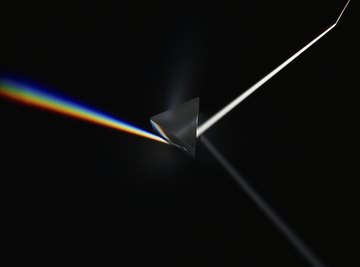

The question of how light travels through space is one of the perennial mysteries of physics. In modern explanations, it is a wave phenomenon that doesn't need a medium through which to propagate. According to quantum theory, it also behaves as a collection of particles under certain circumstances. For most macroscopic purposes, though, its behavior can be described by treating it as a wave and applying the principles of wave mechanics to describe its motion.
Electromagnetic Vibrations
In the mid 1800s, Scottish physicist James Clerk Maxwell established that light is a form of electromagnetic energy that travels in waves. The question of how it manages to do so in the absence of a medium is explained by the nature of electromagnetic vibrations. When a charged particle vibrates, it produces an electrical vibration that automatically induces a magnetic one -- physicists often visualize these vibrations occurring in perpendicular planes. The paired oscillations propagate outward from the source; no medium, except for the electromagnetic field that permeates the universe, is required to conduct them.
A Ray of Light
When an electromagnetic source generates light, the light travels outward as a series of concentric spheres spaced in accordance with the vibration of the source. Light always takes the shortest path between a source and destination. A line drawn from the source to the destination, perpendicular to the wave-fronts, is called a ray. Far from the source, spherical wave fronts degenerate into a series of parallel lines moving in the direction of the ray. Their spacing defines the wavelength of the light, and the number of such lines that pass a given point in a given unit of time defines the frequency.
The Speed of Light
The frequency with which a light source vibrates determines the frequency -- and wavelength -- of the resultant radiation. This directly affects the energy of the wave packet -- or burst of waves moving as a unit -- according to a relationship established by physicist Max Planck in the early 1900s. If the light is visible, the frequency of vibration determines color. The speed of light is unaffected by vibrational frequency, however. In a vacuum, it is always 299,792 kilometers per second (186, 282 miles per second), a value denoted by the letter "c." According to Einstein's Theory of Relativity, nothing in the universe travels faster than this.
Refraction and Rainbows
Light travels slower in a medium than it does in a vacuum, and the speed is proportional to the density of the medium. This speed variation causes light to bend at the interface of two media -- a phenomenon called refraction. The angle at which it bends depends on the densities of the two media and the wavelength of the incident light. When light incident on a transparent medium is composed of wave fronts of different wavelengths, each wave front bends at a different angle, and the result is a rainbow.
References
About the Author
Chris Deziel holds a Bachelor's degree in physics and a Master's degree in Humanities, He has taught science, math and English at the university level, both in his native Canada and in Japan. He began writing online in 2010, offering information in scientific, cultural and practical topics. His writing covers science, math and home improvement and design, as well as religion and the oriental healing arts.
Photo Credits
Marcochow/iStock/Getty Images