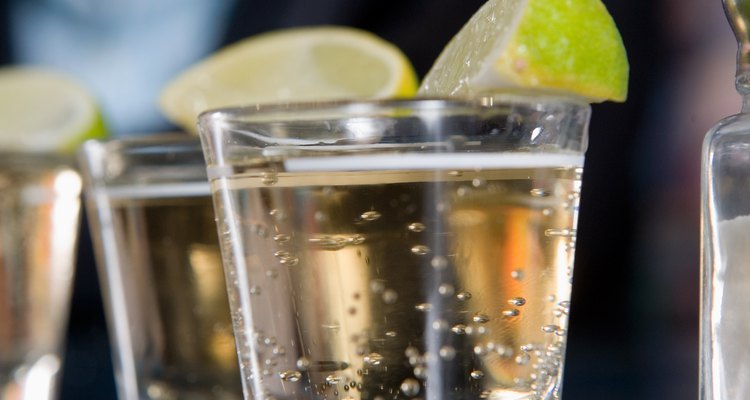
Although tequila may have a rather rough-edged image as the favored tipple of border-town renegades and spring breakers, its production is a highly regulated, conservative affair. Some of its exclusive blends command the prices and respect accorded to fine Scottish single malt whiskies. Authentic tequila is produced only in certain regions of Mexico, and it's labeled as such; alternative varieties can be bottled elsewhere. Tequila's alcohol content is a fairly modest 110 proof.
Proof Basics
A spirit’s proof represents double the percentage of alcohol content, with most spirits typically registering 80 proof. The concept allegedly originated with the 18th century British Royal Navy, when sailors tossed gunpowder into rum and ignited it to check that it had not been watered down. Only spirits with an optimal proof of 114 would ignite and burn with a blue flame. Tequila sold in Mexico tends to be 76 proof, while those intended for export nudge 80 proof. The law sets the minimum proof at 70. If these levels seem low, remember that the average proof used to be higher, around 90 proof, but a shortage of agave in the 1930s led to producers dropping the overall alcohol content.
Real Tequila
Authentic tequila is made only from 100 percent blue agave plant from designated areas, such as the area around Jalisco in western Mexico. These tequilas are exclusive: It takes 17 pounds of blue agave to produce a liter of 100 percent tequila, and this type can only be bottled in Mexico. All 100 percent blue agave tequilas must carry a NOM (Norma Oficial Mexicana) stamp on their label for authenticity. The maximum proof allowed under NOM standards is 110 proof. However, blanco tequila -- a clear liquid made from double-distilled fermented agave juice diluted with distilled water -- logs in at a modest 80 proof.
Tequila Mixto
The other type of tequila on sale, and arguably the most recognizable, is “mixto,” meaning that the spirit is at least 51 percent blue agave, with the remainder from other sugars such as cane sugar, but not the sugars from other species of agave, which is prohibited by law. These tequilas can be bottled outside tequila territory, even abroad, and can be colored with caramel, for example. They are generally the cheaper brand tequilas that find their way into margaritas; 70 percent of the tequila sold in the U.S. is for the cocktail. This type of tequila can contain rougher additives and colors, which are responsible for the unexpected pains that drinkers sometimes experience the day after. “Mixto” tequilas consistently hover around 80 proof but are capped at 110.
Mezcal Spirit
Agave spirit that neither uses 100 percent blue agave plant nor hails from a designated tequila region is not technically tequila, but mezcal. In fact, tequila is a type of mezcal, not the other way round. Hailed by "The New York Times" as “the next big thing” in 2010, mezcal comes from the Oaxaca region in southern Mexico and is produced using the espadin agave. While mezcal does not have the exclusive cachet of blue agave tequila, it is by no means an inferior spirit. It has a stronger, smokier flavor than its cousin. Frequently ending up in cocktails, mezcal proof hovers around 80, with the occasional blend nudging the 110-proof ceiling. While tequila is sometimes associated with a worm, only a handful of mezcal distillers employ the gimmick.
Related Articles

Alcohol Content: Proof vs. Percentage ...
What Is the Highest Proof Vodka?
What Is the Difference Between 80 & 100 ...

What Liquors Are Made From Sugar Cane?
What Is the Highest Proof of Every ...

List of the Different Types of Champagne

What Is Ceylon Sapphire?
Difference Between Percent Alcohol & ...
Triple Sec & Vodka Drinks
The Difference Between Brown and White ...

The Calories of Pacifico Beer
Most Popular Drinks of the 1970s
How Long Does Liquor Keep in Storage?

How Rare Is a Black Pearl?

What Is Cognac Amber?
Can Drinking Old Vodka Hurt You?
The Popular Mixed Drinks of the 50s & ...
What Kind of Mixed Drinks Can I Make ...
What Is 916 in Jewelry?

Brandy Flavoring Substitute
References
Resources
Writer Bio
Nick Marshall is a UK-based writer specializing in trends and best-practice in the B2B sector.
Photo Credits
Jupiterimages/Photos.com/Getty Images