
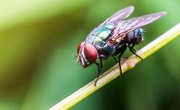
Insects and humans have very different types of eyes, but each has advantages and disadvantages. The insect compound eye is like having lots of little eyes looking in different directions, but each little eye doesn't see very well. The human eye can swivel, but it only looks in one direction at any given moment. The quality of its vision is much higher than that of a compound eye, and it has a much more complex construction.
Structure
Both the insect compound eye and the human type of eye have lenses and light-sensitive cells that allow the eyes to collect data that a brain can form into an image of the surrounding environment. Where insect eyes have many tiny lenses with one lens per ommatidium, or eye subunit, the human eye has a single large lens. The lens of each ommatidium focuses light on a few light-sensitive cells without any adjustments. For human eyes, the iris adjusts the amount of light that enters the eye, small muscles focus the lens on the eye's subject and a large number of light-sensitive cells work together to form an image.
Acuity
Visual acuity is the quality of vision that determines how much detail you can see in a given image. The visual acuity of compound eyes depends on the number of ommatidia in the eye and their size. For the eyes of vertebrates, visual acuity depends on the density of light-sensitive cells in the retina. Dragonflies have one of the highest-quality compound eyes with 30,000 lenses per eye. Birds of prey, such as buzzards, have up to 1 million sensor cells per square millimeter. The eyes of these birds have two to three times the acuity of human eyes, but the acuity of a human eye is still about 100 times better than that of the best insect compound eye.
Color
The light-sensitive cells of the eye determine what colors an eye can detect. The ability to see color is rare in insects and vertebrates, and the human eye is one of the most sophisticated in its ability to see different hues, vividness and shadings. While an insect compound eye has the capability to see color if it contains corresponding sensor cells, most insects can only see light and dark. A few, like bees, see more colors than humans, but they don't have the additional qualities of vividness and shading,
Function
Two of the key functions of the eyes are to detect predators and to identify prey for hunting. Insect compound eyes are better at alerting insects to the presence of a hunter because they can look in many different directions at the same time and are sensitive to the movement of large objects. The hunted insect can then take evasive action. Human eyes are better for hunting because they can clearly see and identify the prey and have vision good enough to track animals by reading the signs they leave behind.
References
About the Author
Bert Markgraf is a freelance writer with a strong science and engineering background. He has written for scientific publications such as the HVDC Newsletter and the Energy and Automation Journal. Online he has written extensively on science-related topics in math, physics, chemistry and biology and has been published on sites such as Digital Landing and Reference.com He holds a Bachelor of Science degree from McGill University.