How Does a Centrifugal Pump Operate?

  1. Discs and Vanes

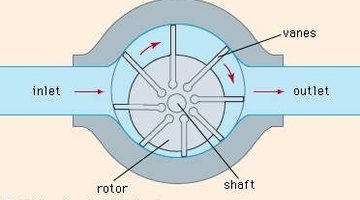
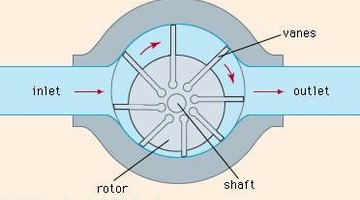
    • Centrifugal pumps utilize a round disc attached to a central shaft. This shaft is generally attached to an electric motor. As the electric motor rotates, it moves the disc in either a clockwise or counterclockwise direction. Machined onto the flat disc is a series of upright fins or vanes. These vanes are set at 90 degrees, or perpendicular to the face of the disc. It is these fins or vanes that serve to move the water from one location to another by creating a difference of pressure. The vanes of a centrifugal pump do not really "push" the water. The vanes create a pressure difference in the liquid in order to move it to another location.

    Drinking Straw and Glass

    • The centrifugal pump has both an inlet and outlet generally clearly marked on the pump housing. Only by properly connecting these two ports of the pump can the pump move a liquid. If you where to connect the outlet to the end of the pipe you wanted to "get" the water from, nothing would happen. In fact, you might just see some air bubbles emitting from that water source. The centrifugal pump creates a suction on the inlet side of the pump much like a person sucking on a straw in a can of soda or a milk shake. As the person pulls in on the top of the straw, a pressure difference is being created between the air pressure pushing down on top of the liquid and the lower pressure being created by the sucking action of the straw. Since the pressure is lower at the entrance of the straw, near the bottom of the liquid, the liquid is forced up the straw and into the drinker's mouth. Stop sucking on the straw, and the liquid stops its movement. The same pressure difference occurs in a centrifugal pump.

    But it Runs Backwards

    • If you were to remove the outside pump housing of a centrifugal pump, you would find a set of curved fins or vanes. These vanes are in the shape of a crescent moon that have a distinct curve to them. The inside face of the vanes actually look like small cups that are lined up with each other, and equally distributed around the central drive shaft. The outside of the pump housing that was removed also has a very distinct shape to its inside chamber. It is larger on the inlet side or inlet port and becomes smaller on the outlet side of the pump opening. In other words, the interior of the pumping chamber is larger in volume on the inlet side of the housing and becomes smaller or "compressed" on the outlet side of the metal housing. This is so as the liquid passes through the pump housing by the suction of the vanes, the liquid is moved to a higher pressure by being compressed before it exits the outlet port. The rotation of the pumping vanes may also seem to run backwards as one may think to "draw" the liquid into the pump housing. Since the designs of the vanes are like small crescent moons or cups, you may think that the cups would "scoop" the water to move the liquid from the low-pressure side to the high-pressure outlet. In fact, the water vanes move in such a way as to use the curves to "pull in" or "suck" the liquid by the action of the rotating crescents or cups. In other words, the curved portions of the vanes pull in the liquid by the crescents passing in front of the inlet port. As the liquid moves to the other side of the chamber, it becomes slightly compressed and wants to exit from the outlet port due to its higher, squeezed pressure.

Related Searches:

Resources

Comments

You May Also Like

  • How to Troubleshoot a Centrifugal Pump

    A centrifugal pump is not too complicated. It has a rotating impeller in a chamber and a motor to turn the impeller....

  • Do Centrifugal Pumps Require a Bypass Valve?

    Centrifugal pumps are used in commercial and industrial applications to pump liquids and slurries. A centrifugal pump consists of an electric motor...

  • Centrifugal Pump Safety

    Centrifugal pumps provide pressure to flowing water. These pumps are essential components to many processing plants. Damage to a pump through incorrect...

  • Taco Pump Troubleshooting

    Taco is a leading supplier of pumps and related equipment for residential and commercial HVAC systems. Their centrifugal pump line makes pumps...

  • How to Prime a Centrifugal Pump

    Centrifugal pumps utilize centrifugal force to push water through plumbing systems. A centrifugal pump spins an impeller at fast speeds which sucks...

  • Difference Between Reciprocating & Centrifugal Pump

    Reciprocating and centrifugal pumps serve different purposes and operate with separate functions. Centrifugal pumps transport huge amounts of liquid at a time,...

  • Advantages of Centrifugal Pumps

    Advantages of Centrifugal Pumps. There are all kinds of pumps. Some pumps have gears and some have pistons or plungers. Some chew...

  • How Does a Marine Jet Pump Work?

    Marine jet pumps are used for propulsion in jet boats and personal watercraft. They work by creating a fast jet of water...

  • How Do Pump Seals Work?

    Pumps are devices that move fluid volume by mechanical or physical action. Pumps use a particular kind of seal in order to...

Related Ads

Featured