This Season
 

How Are Emeralds Formed?

How Are Emeralds Formed?thumbnail
How Are Emeralds Formed?

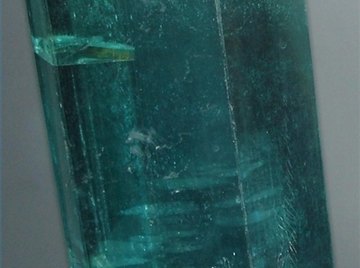
Emeralds are a green to greenish-blue variety of the gem species beryl [Be3Al2 (Si6O18)]. Its color can come from minute amounts of either chromium or vanadium. They are a hard but brittle gem, as flaws are common in their formation. Emeralds form both naturally and through manmade conditions. Manmade emeralds are sometimes called "created" emeralds. Emerald deposits are found in North Carolina and California in the U.S. as well as Columbia, Brazil, Algeria and the Ural Mountains. Common varieties of emerald include the star emerald, Columbian emerald, Zambian emerald, cat's eye emerald, Trapiche emerald and the Brazilian emerald. Common minerals that form next to emeralds are quartz, feldspar and calcite.

Related Searches:
    1. Natural Formation

      • Natural emeralds form in either pegmatite deposits or hydrothermal veins in metamorphic environments. In a hydrothermal vein, hydrothermal fluids have escaped from magma deeper in the Earth's crust. When these fluids contain the specific elements that are in emeralds (like beryllium) and begin to cool in deposit veins, emeralds start to form.

        In pegmatite deposits magma, instead of hydrothermal fluids is the key component in emeralds formation. When the magma cools elements remain in the solution of the fluid left over. When the right elements remain, and optimal conditions such as cooling are in place, emeralds form.

        In these environments temperatures range approximately 750 to 930 degrees Fahrenheit under pressures amounting to one to three kilobars (about 7.5 to 21.75 tons of pressure per square inch). Cooling takes long periods of time: natural emeralds today formed hundreds of millions of years ago.

      Synthetic Formation

      • There are two main types of synthetic emerald formation environments, hydrothermal and flux-growth. The hydrothermal method involves growing a veneer of emerald over a beryl in an acidic environment and a silicon rich "nutrient." The chemicals are heated approximately 930 to 1112 degrees Fahrenheit at pressures of 700 to 1400 kilobars (5076 to 10150 tons of pressure per square inch). The acidic environment keeps the chromium from separating out of the growing medium and the silicon rich nutrient is kept from the other chemicals to keep from stunting the emeralds' growth.

        Flux-growth emeralds involve growing a synthetic emerald over a colorless "seed crystal" beryl. Molybdates, tungstates and vanadates are used to form a "flux." These materials are melted. A beryl is rotated and is placed in contact with a "rotating melt zone," and then removed. This synthesizes the beryl. Wispy feather-like inclusions form often in this growing method.

    Related Searches

    Resources

    • Photo Credit Jorfer

    Read Next:

    Comments

    You May Also Like

    • How Are Emeralds Formed in Nature?

      Emeralds are stones that don't form often or perfectly in nature. Emeralds are a useless gemstone for all practical purposes--the only thing...

    • How Do Emeralds Get Their Green Color?

      Emeralds are beautiful stones that come in a variety of green colors. Some emeralds consist of yellow and blue tones. If you...

    • How to Get Deoxys on the Pokemon Emerald Version

      Deoxys is a psychic Pokemon that can only be obtained from Birth Island in Pokemon Emerald. Birth Island can only be reached...

    • The ABCs of Emeralds

      Emeralds are among the most familiar and highly prized of the precious gemstones. Famed throughout history for their brilliant green color, the...

    • How to Detect Oiled Emeralds

      Due to the nature of emeralds, which often form with fissures naturally, enhancements are common. An emerald enhancement practice that has been...

    • How to Dig for Emeralds

      The emerald is a treasured gemstone that is actually colorless beryl. Through natural erosion, it crystallizes with chromium and forms a brilliant...

    • Questions About Emeralds

      Consider the emerald, a variety of beryl colored green by vanadium or by chromium and long valued by people across the world....

    • What Do Raw Emeralds Look Like?

      Raw emeralds, stones that have not been cut and polished or otherwise treated, present a somewhat rugged image in many cases. Until...

    • How Are Crystals Formed in Nature?

      Visit any gem and mineral show, and you will see crystals in many shapes and colors. But these are only a few...

    • Who Discovered Emeralds?

      The emerald is a highly valued, rare gemstone, coveted for its distinctive green color. Precisely who discovered the first emerald is unknown....

    • How Are Emeralds Processed?

      Emeralds are one of the rarest and most valuable gems in the world. Throughout history, they have been worshipped by the Incas,...

    • Composition of Emeralds

      Emeralds are an opaque to transparent, crystalline, hard mineral (7.5 to 8 on the Mohs scale, on which a diamond is a...

    • How to Make Synthetic Emeralds

      Synthetic emeralds, also known as "created" or "lab" emeralds, are very similar to real emeralds since both gems are of the same...

    • How Are Emeralds Mined Today?

      Since the age of antiquity, emeralds have been mined and cherished. They charmed Cleopatra and dazzled Spanish conquistadors in the New World....

    • Definition of Hydrothermal Vents

      Hydrothermal vents and the convection beneath the surface of the oceans are some of the most recent and unique geological discoveries. Despite...

    • How to Clean Rough Emeralds

      Even though emeralds are considered to be very hard and durable gemstones, care must still be taken to keep from damaging them....

    • Items That Form From Crystals

      Items That Form From Crystals. Crystals are structures of atoms connected in a regular recurring pattern that form a solid, according to...

    • How to Tell Emeralds From Beryls

      There are genuine difficulties in distinguishing emeralds from beryls, as an emerald is actually a member of the beryl family of precious...

    • Types of Emeralds

      The emerald gemstone is a variety of the beryl mineral. The beryl turns green due to chromium and vanadium impurities. There are...

    • About Emerald Cut Diamonds

      The emerald cut diamond ring is a popular type of engagement ring. This rectangle shape offers the wearer a unique style that...

    Follow eHow

    Related Ads