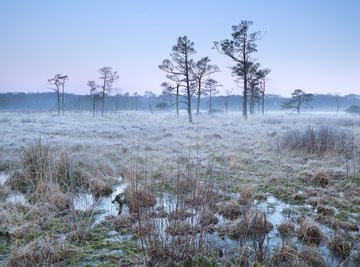
Bogs are a type of wetland containing moss, peat and acidic waters. They can be found in certain low-lying areas that have relatively moist climates with ample precipitation. Bogs require this humid climate to retain the wetness that characterizes them. Bogs are more plentiful in the northern hemisphere than the southern, particularly in areas once covered by glaciers.
Northern United States
In the United States, bogs are mainly found in the Northeast and Great Lakes states. Many of these bogs lie within ancient glacial lakebeds. Some, particularly in New England, serve as nurseries for cranberries.
Southern United States
Special types of bogs known as pocosins can be found in parts of the southeastern United States along the Atlantic Coastal Plain. They differ from the northern bogs in that they typically don’t feature standing water, though their soils are still very moist. Most pocosins are in North Carolina, although some are located in South Carolina, Georgia, Florida and Virginia.
Locations Globally
The bogs that speckle the Great Lakes and northeastern states don’t end at the northern border -- they speckle vast swaths of the east-central Canadian landscape as well. In Europe, bogs are common throughout portions of Scandinavia and the countries bordering the Baltic Sea. In bogs of the British Isles the remains of ancient humans have been preserved for thousands of years. Western Siberia is home to a particularly massive bog. And in 2014, an enormous bog was discovered in the Republic of Congo.
References
- United States Environmental Protection Agency: Bogs
- University of Guelph: Chapter 2: Classification of Wetlands
- Vermont Fish and Wildlife Department: Vermont Fish and Wildlife Habitat Fact Sheet
- British Broadcasting Corporation: Siberia's Rapid Thaw Causes Alarm
- National Public Radio: Peat Bog The Size Of England Discovered In Congo Republic
About the Author
Based in western New York, Amy Harris began writing for Demand Media and Great Lakes Brewing News in 2010. Harris holds a Bachelor of Science in Mathematics from Penn State University; she taught high school math for several years and has also worked in the field of instructional design.
Photo Credits
catolla/iStock/Getty Images