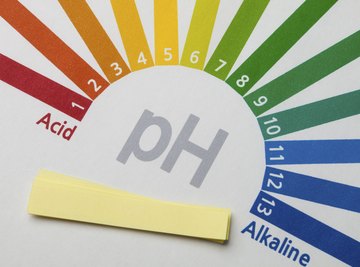

Enzymes are protein-based compounds that facilitate specific chemical reactions in living organisms. Enzymes can also be used in medical and industrial contexts. Breadmaking, cheesemaking and beer brewing all depend on the activity on enzymes -- and enzymes can be inhibited if their environment is too acidic or too basic.
How pH Affects Enzymes
A pH environment has a significant effect on an enzymes. It can affect the intramolecular forces and change the enzyme's shape -- potentially to the point where it is rendered ineffective. With these effects in mind, typical enzymes have a pH range in which they perform optimally. For example, alpha amylase, which found in the mouth, operates most effectively near a neutral pH. However, lipases operate better at more basic pH levels. Buffer systems built into most organisms prevent pH levels from reaching the point where essential enzymes are rendered ineffective. If an enzyme is rendered ineffective by pH level, adjusting the pH can cause the enzyme to become effective again.
About the Author
Brett Smith is a science journalist based in Buffalo, N.Y. A graduate of the State University of New York - Buffalo, he has more than seven years of experience working in a professional laboratory setting.
Photo Credits
phototake/iStock/Getty Images