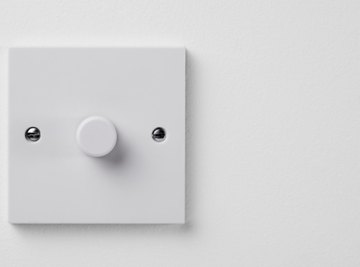

Controlling the light level of an LED (light emitting diode) is no different than controlling the light level of a typical dining room light using a dimmer switch. The dimmer switch is a variable resistor. Resistors are electronic components used to control the current flow in a circuit. The more current a resistor allows to flow in a circuit that has an LED or light fixture attached, the brighter the lamp will shine. By using a variable resistor, the current can be controlled at will to either dim or brighten an LED or lamp in a circuit. The variable resistor in an electronic circuit is called a potentiometer.
- 9-volt battery
- 100-1000 ohm potentiometer
- 5-millimeter red LED
- 3 6-inch lengths of copper wire
Connect one 6-inch wire to the positive terminal of a 9-volt battery. Connect a separate 6-inch wire to the negative terminal of the 9-volt battery. Do not allow the free ends of the two wires to touch each other.
Connect the free end of the negative battery terminal wire to the center lead of a 100-1000 ohm potentiometer (variable resistor). Potentiometers have three leads for connecting to a circuit and a knob for adjusting the resistance that flows through the potentiometer. The center lead is the circuit connection for the negative lead from the battery. The right and left leads are the circuit connections for the positive battery lead.
Turn the potentiometer knob to its middle position to ensure that an excess of current will not flow through the instant the circuit connection is complete.
Attach the free end of the positive battery lead to either the right or left potentiometer lead. Use the right side lead if you want to increase resistance by turning the knob clockwise. Use the left side lead if you want to increase resistance by turning the knob counterclockwise. The circuit is now complete.
Slowly turn the variable resistor knob clockwise and counterclockwise and observe how the LED brightens and dims. You are now controlling the light level of an LED.
Things You'll Need
References
- "Understanding Basic Electronics"; Larry D. Wolfgang; 2006
- "Basic Electricity and Electronics"; Charles Schuler, Richard Fowler; 1988
About the Author
Since 1999, Timothy Boyer has worked as a freelance writer. His career began as a science columnist with "The Northwest Explorer" and as a science writer with McGraw-Hill publishing's Power Web Series of educational articles. Boyer has a Ph.D. in molecular and cellular biology from the University of Arizona.
Photo Credits
Jupiterimages/Polka Dot/Getty Images