Window glass generally must be extremely flat, although there are exceptions such as stained glass. It’s almost always made from soda-lime glass, which is by far the most common type of glass. There are a variety of methods for making window glass, but almost all flat glass is currently made with the float glass method. Window glass is made in a commercial process that uses very large quantities of materials.
- Glassmaker’s furnace
- Limestone
- Silica sand
- Soda
- Tin
Mix the ingredients thoroughly. The exact recipe varies somewhat by application but a typical formula for soda-lime glass is 63 percent silica sand, 22 percent soda and 15 percent limestone. A typical production run might involve 1,200 tons of glass.
Pour the molten glass. Heat the mixture to 1,200 degrees and pour it through a delivery canal into a furnace that contains molten tin, so that the glass floats on top of the tin. The container of tin may be close to 50 meters long.
Let the molten glass form a smooth, even surface. The float process is so-named because the glass floats on top of the tin. Enclose the tin bath in an atmosphere of hydrogen and nitrogen to prevent gaseous oxygen from reacting with the molten glass.
Allow the molten glass to gradually cool to about 600 degrees Celsius. The glass will now be hard enough to be lifted off the molten tin and onto a conveyor belt. The speed of the conveyor belt will determine the thickness of the glass, since a faster speed will cause the glass sheets to be thinner.
Cool the glass down to room temperature. The kiln will gradually cool the glass on the conveyor belt over the course of about 100 meters. This will prevent the glass from breaking due to a sudden temperature change. The glass sheets may then be cut to any desired size.
Things You'll Need
About the Author
Allan Robinson has written numerous articles for various health and fitness sites. Robinson also has 15 years of experience as a software engineer and has extensive accreditation in software engineering. He holds a bachelor's degree with majors in biology and mathematics.
Photo Credits
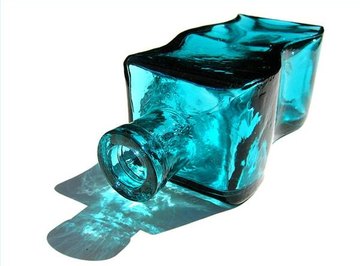
"Colorful Bottle" Photo by Matthew Bowden (www.digitallyrefreshing.com)