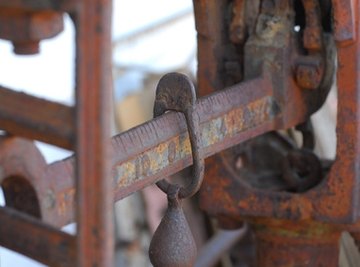

A balance scale is an instrument used to measure the weight of objects by comparing their weights to a set of known weights. Lady Justice, a symbol of an impartial legal system since Ancient Rome, is seen holding a balance scale, on which she is said to weigh the merits of both sides of the case. The sliding scales common in doctors' offices are also a form of balance scales.
Beam Balance Scales
Place the object to be weighed on a pan on one side of the scale.
Add objects with known weights to the pan on the other side of the scale until the beam connecting the pans is level. The pans may be mounted on the beam on the beam or they may hang from the beam. Either way, the beam should become level.
Calculate the weight of all the objects that were added to the second pan. That value is the weight of the object in the first pan.
Sliding Balance Scales
Some beam balances are precise enough that it is difficult to get the beam perfectly horizontal and an estimate must be used.
Place the object to be weighed on the pad or pan, depending on the type of scale. Some sliding balance scales are used to determine a person's weight and are designed so that a person can stand on the pad and operate the sliders at the same time. Others are designed for laboratory use and are small enough to sit on a table. Either way, the basic operation is the same.
Adjust the sliders along the beam until it is horizontal and balanced. Many of these scales will have an arrow or pointer at the end of the beam which will point to a fixed mark to indicated it is balanced.
Add the values the sliders are pointing to in order to get the total weight.
Tips
Tips
- Some beam balances are precise enough that it is difficult to get the beam perfectly horizontal and an estimate must be used.
Photo Credits
Old mechanical scale image by Heng kong Chen from Fotolia.com