Geiger Counters
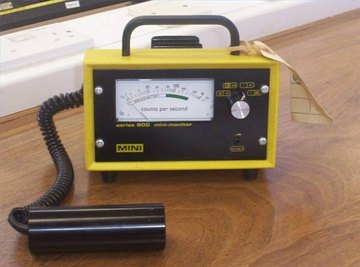
A Geiger counter is what most people mean when they think of a radiation detector. This device uses a Geiger-Müller tube as the sensor. This tube is filled with an inert gas that becomes conductive for a brief flash when a particle or photon passes through it. This flash of electricity is then measured on a gauge, by audible clicks or both. A large amount of radiation passing through the tube produces a higher reading and more clicks because of the greater amount of electric current being generated inside the tube. The gas contained in the tube can be argon, helium or neon. Geiger counters are useful for detecting the ionizing radiations: alpha, beta and gamma rays. However, most hand-held Geiger counters are at their best with alpha and beta rays. The density of the gas within the tube is usually sufficient for these two rays but not for high-energy gamma rays.
Particle Detectors
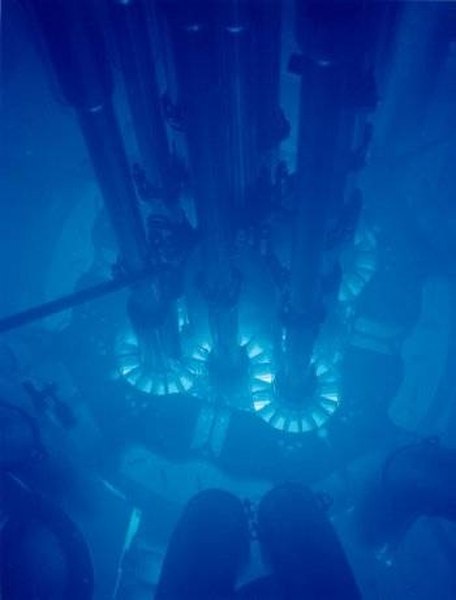
These are large, laboratory devices used to detect a wide variety of particles. They are also sometimes called radiation detectors, because radiation and charged particles are often synonymous. Particle detectors are highly specialized devices, and many can only detect one or a few types of radiation. An example is the Lucas Cell, which works by filtering gas samples and counting the radioactive particles, which is a means of measuring the radioactive decay in substances like uranium or cesium. Other detectors work by filling tanks with a given substance, chosen because it reacts when struck by a particular kind of radiation and converts into something else. By measuring the change in the composition of the tank contents, radiation can be detected and measures. Cerenkov radiation detectors look specifically for that radiation, which is produced when particles travel faster than light when both passing through a given medium. The medium is usually a gas or liquid that slows light considerably but not some high energy particles.
Hermetic Detectors
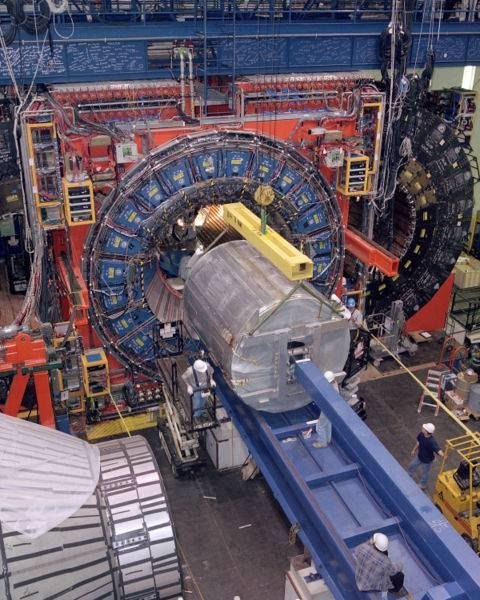
Hermetic detectors are designed to incorporate different detector designs to measure all possible radiation. They are usually built around the interaction center of a particle collider and are called "hermetic" because they are supposed to let as little radiation as possible escape without measurement or even to let it escape at all. Hermetic detector designs come in three layers. The first is a tracker layer. This measures the momentum of charged particles as they move in a curved arc through a magnetic field. The second is the layer of calorimeters, which work by absorbing charged particles into dense substances for measurement. The third is a muon system. This measures muons, the one type of particle that will not be stopped by the calorimeters and yet can still be detected. It is important to understand that while most hermetic detectors share this three layer design principle, the actual instruments used in each layer can vary greatly. These are large, complex, purpose-built and custom-made devices, and no two are exactly alike.
Photo Credits
Wikimedia Commons