


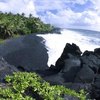

Rare, black sand exists because of igneous rock material, which is pulverized over eons by the surf and thrown onshore as sand. Beaches of this sort are usually made up of small lava fragments, which originated as lava flows reaching the cool sea. As the hot lava poured into the ocean, it suddenly burst into black sand and basalt bits. The earth’s unusual shadowy sand areas exist in the tropics under azure skies, in other parts of the world with grayer conditions and in off-the-beaten track locations.
Punaluu Beach, Hawaii
One of the most famous black sand beaches in the world is Punaluu Beach, located between Hawaii Volcanoes National Park and the small town of Naalehu on the Big Island of Hawaii. Black sand beaches are hot, because black absorbs the sun's heat and, naturally, barefoot trekking can be shocking during the day. While the beach is not the best for swimming, you can revel in the sea turtles that sometimes emerge from the cool water to rest on the warm beach.
Kaimu Beach, Hawaii
The world’s newest black sand beaches on the Big Island of Hawaii, Kaimu Beach at Kalapana is at the end of the road leading to Kalapana, followed by a ten minute walk to the new beach -- according to Tom’s Barefoot Tours (tombarefoot.com). In 1990, lava inundated the beach and Kalapana village. The surf continues to reshape the emerging black sand beach, where ferns and other plants, including fledgling palm trees, now appear in the lava cracks.
New Zealand and Tahiti
A windswept rugged coastline less than an hour north of Auckland, New Zealand is a showcase for Muriwai's astonishing hard black sand. Extremely rigid, the sand area is designated an official highway, which permits vehicles to drive on the black beach to the edge of the water. A historic natural source of iron ore for New Zealand iron-making, the sand comprises a volcanic mixture of iron, titanium and vanadium. Beaches in Tahiti are legendary for their black, volcanic sand. A favorite with surfers, Papenoo extends for several hundred yards, while families take to the black beach at Venus Point and its iconic lighthouse.
Vik Beach, Iceland
This black sand beach is located in a the small village of Vik, Iceland. The black sand beach by the same name remains one of the world’s most beautiful black basalt sand beaches. Vik Beach rests on the island's south edge at the confluence of the North Atlantic and Arctic Oceans about 100 miles away from Reykjavik, Iceland’s capital. Between Iceland and the Arctic Circle, there are no land masses, so the area is subject to extreme weather and pounding surf, making Vik's position one of the wettest places on Earth. The black beach’s nearby cliffs house a significant puffin population, whose beaks turn bright orange during the breeding season.
Lesser Antilles Islands, Caribbean
Some Caribbean islands with volcanic pasts exhibit black sand beaches. In the Lesser Antilles Islands chain, St. Lucia’s black sand beaches, some of which have been mixed with imported white sand for tourists reasons, include Anse du Cap and Anse Bucne, and the black and gray sand beaches at Anse Cochon. On the island of Dominica, the small Black Sand Beach nestles in a cove near Napier’s Beach and is reached by trails. Grenada Beaches, Lance Aux Epines and St. David's, offer mixed black and white sand beaches on a remote east side of the island, while St. Kitts’ black sand beaches are at Pump Bay, Dieppe Bay, and the gray-black sands of Conaree Beach.
References
Photo Credits
- Karl Weatherly/Photodisc/Getty Images