What Is the Oil Drilling Process?

  1. Setup

    • Before a well can be drilled, a lot of preparation must take place. Geologists and other scientist must study the site to determine if oil should even be present and environmental studies must be done in most countries. If the site is suitable, then the equipment must be brought in and set up, along with a crew to operate it. Once the drilling rig is in place and all the equipment and personnel available, then drilling can commence.

    "Making Hole"

    • The "tool," or the drill bit assembly, is put together and brought to the drill floor beneath the derrick. Drill pipe is also brought up and attached to the tool. The driller sits in a compartment commonly called the "doghouse" and operates the drill motor, pushing the tool into the ground. He can control variables such as the pressure exerted by the bit and rotation speed from that position and must monitor many other variables all while overseeing the roughnecks outside the doghouse on the drill floor.

    Roughnecking

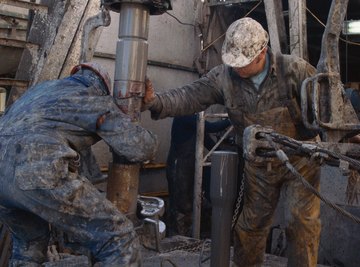
    • When the bit reaches a certain depth, another stand of drill pipe must be added. The roughnecks detach the drill motor from the drill pipe and use winches or other lift devices to pull another stand of pipe up to the drill floor. Some rigs are designed to store drill pipe in the derrick to save space and to help make changes quicker. The new stand of pipe is attached to the drill motor, which is then run up the derrick. The other end of the new stand of pipe is connected to the previous stand already in the hole by the roughnecks. The driller can then begin advancing the drill once again.

    Mud

    • Drilling fluid, or drilling mud, is pumped through the drill pipe to lubricate the bit as it operates. Mud is very specifically formulated for each hole and even for different conditions in a hole. A mud engineer is on site to make sure the formula meets the specifications required for the job. The mud that reaches the bottom of the hole is pushed back up along with the clippings left behind by the drill bit. This mixture is poured over screens mounted to machines called shakers. These machines separate the clippings from the mud so the mud can be reused. Geologists and other scientists and operators can examine the clippings to determine what the conditions of the well are likely to be as drilling continues.

    Casing

    • At some point in the drilling process, casing will most likely be added to the well. This is a heavy lining designed to support the walls of the well so it does not collapse in on the drill pipe and the tool. First, a cement footing is put in place at the bottom of the well. The cement engineer formulates the cement mixture to ensure it can withstand the stresses that will be placed on it. Casing is placed in the hole by the driller, using the same connect-disconnect process that was used for drill pipe. After the casing is in place, drilling recommences, starting with the center of the cement footing.

    Repeat

    • As long as there are no problems in the well, such as a bent pipe or a collapse, this process is repeated until the rig reaches the depth it was ordered to reach. These types of wells are called exploratory wells and may or may not strike oil. A production well uses the same processes, except it is drilling into a known production site. Once reaching its target, a pump will be put in place to extract the oil.

Related Searches:

Resources

Comments

You May Also Like

  • Facts About Oil Drilling

    The first modern method of oil drilling developed by Edwin L. Drake in 1859 is still being used to this day, though...

  • What Is Oil Drilling?

    Oil drilling is the process by which tubing is bored through the Earth's surface and a well is established. A pump is...

  • What Is the Definition of Oil Drilling?

    Oil drilling is the process of perforating the earth's surface and rock layers to extract fossil fuels, or oil, for energy production....

  • How Does Offshore Drilling Work?

    Offshore oil drilling is a process dictated by the depth of oil and gas reservoirs buried underneath the ocean. By drilling into...

  • What Are the Negative Effects of Oil Drilling?

    Drilling oil is an energy intensive process that releases pollutants into the air. Increased drilling means that countries have less reason to...

  • Oil Drilling Restrictions in Illinois

    Oil Drilling Restrictions in Illinois. The Oil and Gas Division of the Office of Mines and Minerals of the Illinois Department of...

  • How to Drill For an Oil Well

    Operating oil drilling equipment requires basic knowledge, according to Lone Star Securities, but the process also requires sophisticated engineering knowledge and ...

  • Oil Sands Drilling Methods

    Oil Sands Drilling Methods. Oil sand, also known as tar sand, is a form of soil that is made up of sediment...

  • Offshore Drilling Dangers

    Offshore drilling is done by rigs designed to remain steady in gulf and ocean waters. These specialized rigs drill wells and insert...

Related Ads

Featured