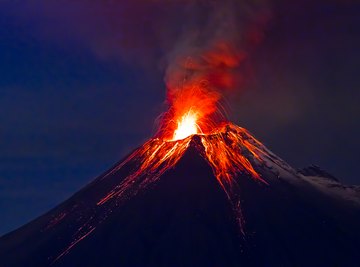

The term “volcano” refers to an opening in the Earth’s surface from which lava, gases, ash and rock fragments erupt. The structure of a volcano grows with every eruption. Below the surface, lava is called magma and builds up in underground reservoirs. Magma and other volcanic materials are channeled to the surface where they are expelled through a crack or hole. The main parts of a volcano include the magma chamber, conduits, vents, craters and slopes. There are three types of volcanoes: cinder cones, stratovolcanoes and shield volcanoes.
Parts of a Volcano
The magma chamber is a hollow within the volcano where magma and gases accumulate. During an eruption, these volcanic materials move from the magma chamber toward the surface via a pipe-like passageway called a conduit. Some volcanoes have a single conduit, while others have a primary conduit with one or more additional conduits that branch off it.
A vent is an opening on the surface of a volcano that emits lava, gases, ash or other volcanic materials. Some volcanoes have multiple vents, but there is only one main vent, or central vent. An operational definition of main vent is the opening where volcanic materials emerge from the primary conduit.
At the top of the volcano, the central vent may be surrounded by a bowl-shaped depression called a crater. Craters form when explosive eruptions occur. Eruptions are more explosive when magma contains a lot of gases and the volcano forcefully expels a large quantity of ash, rock fragments along with those gases.
The slopes are the sides or flanks of a volcano that radiate from the main or central vent. Slopes vary in gradient depending on the intensity of the volcano’s eruptions and the materials that are expelled. Explosive eruptions of gas, ash and solid rock create steep slopes. Slow-flowing molten lava creates gradual slopes.
Cinder Cones: Short and Steep
Cinder cones have a simple structure with a single opening. They are composed mainly of ash and dark volcanic rock called scoria. A single conduit leads from the magma chamber to a central vent. Magma that erupts from a cinder cone has a high viscosity. Because of its thick consistency, the gas in the lava causes it to erupt forcefully, and the cinder cone vent emits a powerful blast of gas-filled lava along with pieces of rock blasted. The emissions harden quickly and break into small particles called cinders. The resulting structure is a volcano with steep sides rising no more than 1,000 feet above the ground. Cinder cones have a flat top with a wide circular crater and are made of layers that form from each eruption. The individual layers vary in slope depending on the intensity of the eruptions that formed them. Cinder cone volcanoes are found throughout the western U.S., with dozens located in Craters of the Moon National Park in Idaho.
Stratovolcanoes: Tall and Majestic
Stratovolcanoes are also called composite volcanoes and are built of layers of volcanic debris that rise thousands of feet above their bases. Eruptions from stratovolcanoes vary in the materials they expel. Layers may be composed of cooled liquid lava, ash or solid debris, which produces volcanoes with steep sides and a conical shape. Some of the most picturesque mountains in the world – Mt. Fuji, Mt. Ranier and Mt. Shasta – are stratovolcanoes. These volcanoes have a central vent surrounded by a crater, and some may have multiple vents.
Shield Volcanoes: Low and Slow
Shield volcanoes are named for their shape. The flattened dome has gentle slopes that resemble the shape of a curved shield. In addition to a central vent, these volcanoes sometimes have multiple vents around the top of the dome and the upper portion of the slopes. As magma rises from the magma chamber, the conduit branches into secondary passages. These passages lead to vents on the flanks – areas of the slopes that are adjacent to the crater. Shield volcano eruptions are primarily lava flows, which contribute to their gradual slopes. The lava cools slowly and spreads out over a wide area, producing slopes of only 5 to 10 degrees. The Hawaiian Islands are made up of shield volcanoes, including the largest active shield volcano in the world.
References
About the Author
A.P. Mentzer graduated from Rutgers University with degrees in Anthropology and Biological Sciences. She worked as a researcher and analyst in the biotech industry and a science editor for an educational publishing company prior to her career as a freelance writer and editor. Alissa enjoys writing about life science and medical topics, as well as science activities for children