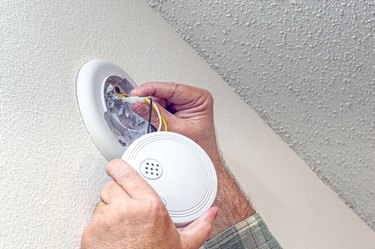
Most deaths from fires in the home occur not because of the flames but are due to smoke inhalation, so a working series of smoke alarms is the first line of defense in keeping your family safe. Hardwired smoke detectors offer a belt-and-suspenders approach because they're tapped into your home's electrical system while also containing backup batteries. Some types of hardwired smoke detectors may also be hooked into your home's security system. This ensures that your local firefighters are alerted when the alarms go off, saving precious time when every second counts.
What Are Hardwired Smoke Detectors?
Video of the Day
Hardwired simply means that the smoke alarms are physically attached to your home's electrical wiring. The term is used to distinguish this type of smoke alarm from the less expensive, more easily changed battery-powered smoke alarms that adhere to the wall with double-sided tape or are attached with screws.
Video of the Day
Different Types of Smoke Detectors
The advantage of a hardwired smoke alarm system is that if one alarm goes off, they all do. The disadvantage is that they won't work in a power outage unless they have functioning backup batteries. There are two basic types of hardwired smoke detectors.
One type uses a 2-wire connection to power the sensors and the alarm. This kind won't function as hardwired unless it's connected to a home alarm system. It's best for smaller dwellings because there's a limit to how many smoke alarms can be connected to the alarm system's control panel. Also, not all home security panels will support a 2-wire system, so make sure that yours will before purchasing new smoke alarms.
The second type of hardwired smoke alarm has a 4-wire connection. Two of the wires power the sensors and the other two wires power the alarms. Most home security control panels will support a 4-wire system, and you can pretty much connect as many smoke alarms to it as you need. Hardwired smoke alarms can also be connected to your home's electrical system if you don't have a home security system.
How Hardwired Smoke Alarms Work
Smoke alarms are designed to detect smoke in two ways. A photoelectric smoke alarm includes a light source, such as an LED light or laser, that sends a beam of light across the inside of the little round smoke alarm chamber from side to side. This beam forms a straight line just above the light sensor in the smoke alarm. When smoke enters the alarm, it disrupts and scatters the light beam, bouncing light off of the sensor, which sets off the alarm.
Inside an ionization smoke detector is a battery that's connected to two tiny metal plates, one of which is a positive electrode and the other is a negative electrode. Also inside of the smoke detector is a substance called Americium-241, which separates air into positive and negative ions. As far as ions go, opposites attract, so the positive ions keep moving toward the negative electrode and the negative ions toward the positive electrode, forming an electrical circuit. When smoke enters, it scatters the ions, disrupts the circuit and sounds the alarm.
A photoelectric alarm is more sensitive to fires that smolder and cause a lot of smoke while an ionization smoke alarm is best for detecting fires that burn faster, with more immediate flames but less smoke. The most effective option is to find a hardwired detector that combines both photoelectric and ionization technology. Whatever type you choose, it's crucial to make sure that your hardwired smoke alarms always have fully functioning backup batteries.
Basic Care and Maintenance
All types of smoke alarms should be tested once or twice every year, though those that run on batteries alone should be tested monthly. The simplest way to keep from forgetting is to check your smoke alarms when you spring ahead and fall behind with daylight saving time. If you live in a state like Arizona, which doesn't change its clocks, check your smoke alarms on Christmas Eve and the Fourth of July.
Checking your smoke alarms isn't difficult. Simply press the test button and see if the alarm responds at full volume. It's a good idea to warn family members and make sure there's someone standing by to comfort scared pets or young children because smoke alarms are designed to be loud and startling.
If the alarm is piercing and full, your hardwired alarm is good for six months, but you should change the backup batteries just to be safe. If the alarm is weak or doesn't sound at all, check to be sure that the wiring is intact and replace the backup battery. If it still doesn't work, you might need to install a new smoke alarm to keep your family safe. Wipe the outside of your smoke alarm to make sure that no dust is obscuring its sensors before replacing the outer shell.