Things You'll Need
Steel rod
Drill
Spare pencil lead
Spare metal ballpoint pen with spring-loaded mechanism
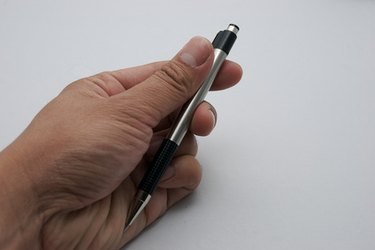
A mechanical pencil is a great tool for sketching, drafting and writing, with all the convenience of an erasable pencil but without the hassle of needing a sharpener to keep your point in working order. You can make a mechanical pencil of your own with plenty of heft by using a metal rod and simple metalworking tools. Your homemade mechanical pencil can be decorated by you as you see fit, and will provide you with added satisfaction the next time you need a pencil.
Step 1
Remove a steel rod from a broken or recycled copy machine. The rod should be the thickness of your mechanical pencil and will serve as the body for the internal lead and spring mechanism.
Video of the Day
Step 2
Shear off both ends of the rod about 6 inches long so that the ends are perfectly flat. Press a divot into the flat end of the rod and drill through the center of the rod to hollow it out using a drill. For added precision, clamp the rod inside a drill stock so that it will hold steady while rotating, then insert the drill bit into the rod.
Step 3
Use the drill bit against the side of one end of the rod to make a series of parallel lines 1/16-inch wide around the outside that will be the pencil grip.
Step 4
Remove the bottom of the ballpoint pen, including spring and internal loading mechanism. Alternatively, you may purchase these parts from a craft or woodworking store.
Step 5
Cut threads into the inside of the mechanical pencil. This will be where the metal tip, scavenged from the metal ballpoint pen, screws in. Cut the bushing from the metal ballpoint pen to fit inside the other end of the mechanical pencil body.
Step 6
Polish the entire mechanical pencil body carefully to remove any metal splinters left over from drilling and cutting.
Step 7
Screw the pen tip into the the top of the pencil. Push the pencil lead and spring mechanism inside the pencil, then seal it by pushing the bushing into the bottom. Tap it in with hammer or mallet as necessary.
Tip
You can make a pen clip by cutting a piece of metal and bending a small tab at a right angle approximately 3/8-inch from the end. Drill a hole into the tab big enough for the bushing to fit through. Polish the clip well to remove splinters, then reassemble the mechanical pencil so that the tab with the hole at the end is between the pencil body and the bushing, and the clip lies flush against the pencil.
Video of the Day