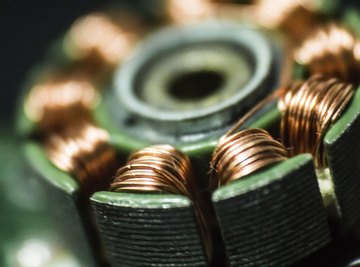

Almost inevitably, you will come to a point in your life where you will be faced with an unhappy small child and a moving toy that no longer moves. You might take the toy apart, relying on your handiness to save the day, but, when left with a pile of components, you may well wonder how those coils of bright wire create motion. Broken toys aside, electric motors are found in many of the devices that make our modern society move, from cars to clocks to the cooling fan in your computer.
Parts of an Electric Motor
An electric motor creates rotational, or circular, motion. The central part of the motor is a cylinder called the armature or rotor. The armature holds the rest of the components and is also the part of the motor that spins. Around the armature is the stator, which holds insulated coils of wire, usually copper. When a current is applied to the motor, the stator generates the magnetic field that drives the armature. Depending on the design of the motor, you might also find brushes, or fine metal fibers that keep current running to the opposite side of the motor as it spins.
Making It Work
You may have noticed that, when you have two magnets, opposite poles attract and like poles repel. The electric motor uses this principle to create torque, or rotational force. It is not the electric current per se, but the magnetic field it creates that generates force when an electric motor is in motion. Electricity moving through a wire creates a circular magnetic field with the wire as the source and center of the rotation. When you add current, the stator and armature form a stable magnetic field and an electromagnet that is pushed or rotated within that field, respectively.
Different Types of Electric Motors
The basic motor runs on DC, or direct current, but other motors can run on AC, or alternating current. Batteries produce direct current, while the outlets in your home supply alternating. In order for a motor to run on AC, it requires two winding magnets that don’t touch. They move the motor through a phenomenon known as induction. These induction motors are brushless, since they don’t require the physical contact that the brush provides. Some DC motors are also brushless and instead use a switch that changes the polarity of the magnetic field to keep the motor running. Universal motors are induction motors that can use either source of power.
Building a Simple Electric Motor
Now that you have the basic parts and principles, you can play with the concept at home. Make a coil from lower gauge copper wire and poke each end through an aluminum can to suspend it. Place a small, strong magnet on either side of the suspended coil to create a magnetic field. If you attach a battery to both cans using alligator clips, your coil will become an electromagnet and the copper wire rotor you created should start to spin.
References
About the Author
Based in Wenatchee, Wash., Andrea Becker specializes in biology, ecology and environmental sciences. She has written peer-reviewed articles in the "Journal of Wildlife Management," policy documents,and educational materials. She holds a Master of Science in wildlife management from Iowa State University. She was once charged by a grizzly bear while on the job.
Photo Credits
TETE3138/iStock/Getty Images