
The Flame
Butane lighters work by releasing liquid butane, stored in a pressurized chamber, in a narrow stream of gas. A spark, made by striking a flint with steel or by compressing piezoelectric crystal, ignites the gas.
Because butane turns liquid quickly when compressed, and just as quickly returns to gas with reduced pressure, it makes an ideal gas for use in lighters. Release the pressure in the holding tank (or a measured amount of it), and some of the liquid immediately returns to its gaseous state and squirts out the opening to meet its flaming destiny at the spark.
Butane's flame is similar to that of a burning candle. Just as a candlewick draws only as much of the liquid wax as it needs to fuel its flame, so using a butane lighter only uses as much liquid butane as it needs to support its flame, only slowly reducing the amount of liquid propane in the holding tank.
The Lighter
The fuel tank of most lighters is made of plastic parts ultrasonically welded together to make a low-pressure pressure vessel. A small metal ball seals the tank after filling.
A sub-assembly (of differing designs, depending on the manufacturer) uses the size (interior diameter) of the "venturi" to release a constant level of gas, permitting a steady flame of predetermined height.
The "spark wheel," made of serrated and hardened steel wire that, when rotated, creates a spark from the flint.* A spring pushes the flint upward to keep it in positive contact with the spark wheel.
Various plastic and metal parts control the opening and closing of gas coming from the valve at the same turning wheel creates a spark. The lighter provides the user with a "fork" that opens and closes the gas vent. The "fork" requires positive pressure to remain open.
The fork can be a trigger pulled with a finger (as, for instance, in a pistol-like fire or candle lighter) or a mechanism that is pushed downward as the user spins the spark wheel, as in a cigarette, pipe or cigar lighter.
Most manufacturers design the caps of their lighters in steel. The cap serves as a windshield, as heat protection, and dilutes the butane with a measured amount of air.
Kinds of Butane Lighters
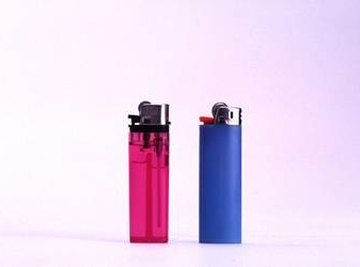
Manufacturers market many different kinds of butane lighters that offer selected secondary benefits based on user needs or desires. There are decorated lighters, lighters with engraved or attached logos, limited edition lighters, "dress" lighters, disposable lighters in different sizes, lighters to light candles, outdoor cooking stoves or wood-based fires and more.
Some higher end butane lighters use a button that, when pressed, compresses a piezoelectric crystal. The compressed crystal creates a voltaic arc that ignites the gas. Otherwise, the process is the same.
About the Author
Steve Gross has been writing professionally for 35 years. Gross holds a Bachelor of Arts in English and a Bachelor of journalism and Master of Arts in journalism from the University of Missouri. He edited and published "DuPont’s Journal of Teflon®" and "Engineering Design Magazine" for 23 years. He founded "Seaside Properties" real estate magazine in 1991 and now works as a full-time freelancer.
Photo Credits
Disposable Butane Lighters