
How Does a Football Helmet Protect a Football Player?
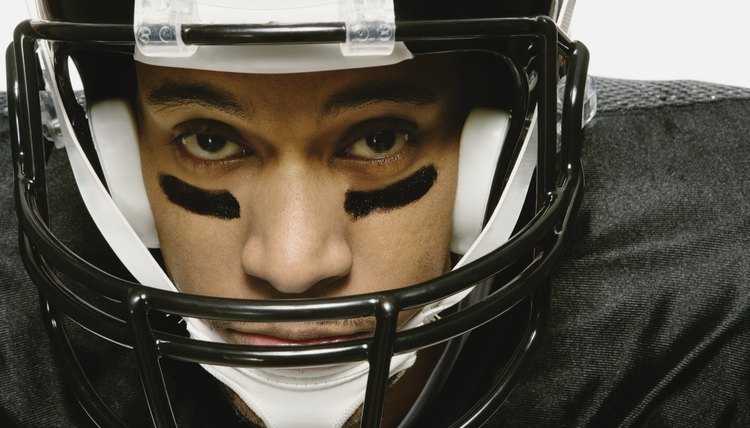
Football helmets are designed to minimize the risk of player concussions and prevent such injuries as facial lacerations, bone fractures and tooth loss. Each component of a helmet has a specific purpose in protecting a player's head. Maximum protection of a player's head relies on wearing the helmet properly.
Helmet Safety Guidlines
The National Collegiate Athletic Association as well as the National Federation of State High School Associations each require football helmets to meet safety specifications of the National Operating Committee on Standards for Athletic Equipment. Helmet manufacturers have agreed to sell only helmets meeting these standards. NOCSAE advises that football helmets be tested on a yearly basis by reconditioning specialists. Reconditioning providers must follow NOCSAE standards. A helmet not meeting NOCSAE standards is rejected and cannot be used again. NOCSAE has no policy on helmet longevity, but the National Athletic Equipment Reconditioning Association suggests discretion when deciding the number of years a football helmet remains in circulation.
Outer Shell Deflects Impact
The outer portion of the football helmet is made from a polycarbonate alloy that is strong, flexible and durable. The outside of the helmet is designed to deflect the force of impact to a player's head.
Padding Serves Multiple Purposes
Padding inside the football helmet provides additional safety and comfort. The padding helps absorb the force of helmet impact. Some helmets include an inflatable liner system to provide a better fit while others use a shock absorber design. Helmet pads are made of thermoplastic polyurethane material, known for its elasticity and resistance to dirt created by sweat and skin oils. The padding is secured in the helmet by velcro or snaps. Pad placement design allows greater ventilation to minimize the heat inside the helmet.
Protecting the Face and Teeth
Improvements in face mask designs have created more protection for a player's facial bones and mouth area. The style of face mask installed on the helmet depends on the player's position. Quarterbacks, running backs, wide receivers and defensive backs traditionally wear face masks protecting the jaw and part of the nose while providing a greater line of vision. Linemen and linebackers wear face masks that provide full facial protection.
Buckle Up the Chinstrap
The chinstrap firmly secures a football helmet to a player's head. For a football helmet to provide maximum protection, the chin strap must be properly fastened. A properly fastened chinstrap is tight enough to prevent the helmet from moving away from the player's head in any manner. It is common for helmets to have four points to snap the chinstrap in place.
Matching the Helmet and the Player
The football helmet is a piece of safety equipment. If not properly fitted, a player is at greater risk for injury. Football organizations receive proper fitting instructions from the helmet manufacturers. Players need to inspect their helmets before each use. Make sure the face mask is tightly secured, the inside pads are in good condition, the chin strap is properly in place and the helmet maintains a secure, tight fit to the head.
References
Writer Bio
Sean McCormick has several years of media experience (writer, news director, reporter, talk host) and has held coaching positions in high school and college football for over 15 years. McCormick has contributed articles to "Coach and Athletic Director" magazine, as well as several internet sites. McCormick received a Master of Science in athletic administration from Ohio University, as well as a Bachelor of Arts in journalism from Point Park University.