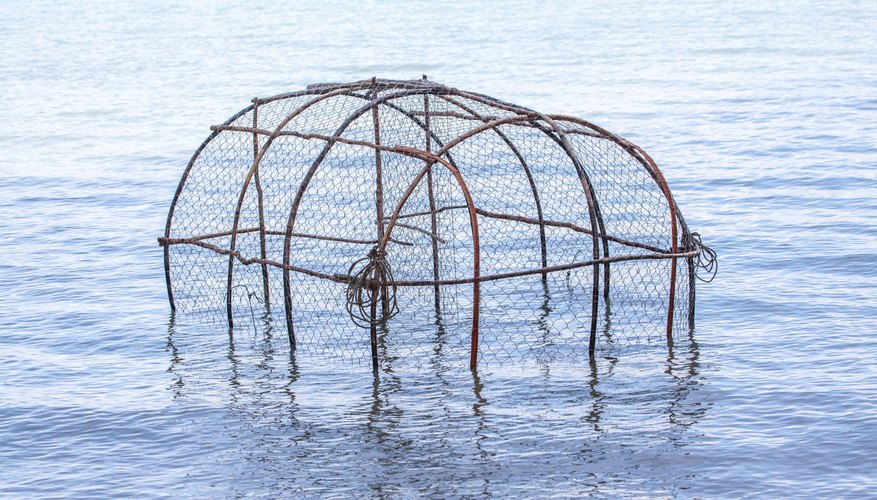


Shrimp are small crustaceans that anglers commonly catch for both bait and food. One passive technique that catches shrimp is a trap, which consists of a wire cage with funnel-shaped entrances that point inward. The fisherman places bait within the trap and leaves it in the water for a period of time. As plankton congregate around the bait, the shrimp swim through the funnel entrances to feed on the plankton, but are unable to navigate out again. The fisherman can then retrieve the trap and recover the captured shrimp.
Shrimp trap
Weighted line
Marker buoy
Bait
Fishing weights
Check the regulations for your areas concerning the use of shrimp traps.
Tie a length of weighted line to your shrimp trap that is longer than the depth at which you will fish. Weighted line with a lead core sinks, preventing boats from hitting your trap lines. Attach a proper shrimp trap buoy to the other end of the line. Ensure the buoy and trap meet with all regulations for identification markings.
Check that the trap is weighted properly for the area you will fish. Use more fishing weights for deeper areas, less for more shallow places. Make sure the weight is evenly distributed on the trap. A trap that flips up on one end because of poor weight distribution will fail to catch shrimp properly.
Open the door to the trap, and then open the bait cage within the trap, if it has one. Load the cage with bait or hang the bait from a plastic mesh bag inside the trap. Use cans of cat food with holes punched in them, bait fish or fish carcasses zip-tied together, ground chum in a fine mesh chum bag or other protein-based baits. Ensure that the bait is securely in place. Close the bait cage, and then close the trap door securely.
Locate a prime area where shrimp are running that does not have an excessive amount of traffic. Drop a measuring line and weight overboard or use your electronic depth finder to ensure the area is not too deep for your shrimp trap line. Put the trap overboard and allow it to sink to the bottom.
Maintain the trap underwater for at least 12 hours. When you return to the trap, carefully haul it to the surface. Bring the trap on board, open the door and remove any shrimp. Re-bait the trap, and place it back in the water for another round.
Items you will need
Tips
References
Tips
- Check the regulations for your areas concerning the use of shrimp traps.
Writer Bio
In Jacksonville, Fla., Frank Whittemore is a content strategist with over a decade of experience as a hospital corpsman in the U.S. Navy and a licensed paramedic. He has over 15 years experience writing for several Fortune 500 companies. Whittemore writes on topics in medicine, nature, science, technology, the arts, cuisine, travel and sports.