

The common incandescent light bulb consists of several parts, some of which you can see, and a few you can't. Thin glass forms the exterior of the bulb, called the globe. It contains the filament which gives off light, a stem, which holds the filament, and a metal base that screws into a socket, such as in a lamp or ceiling fixture. The parts function together as one of the most successful inventions of all time.
TL;DR (Too Long; Didn't Read)
Parts of a light bulb: the glass globe, the metal filament, wires and glass stem, gases and metal base.
The Globe
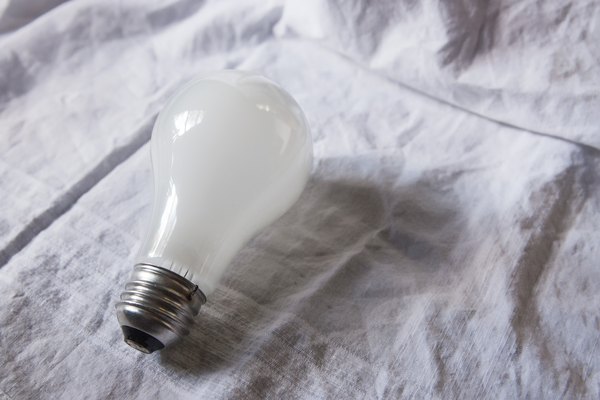
The outer glass shell of the light bulb is called the globe. The glass ensures maximum light efficiency and provides strong support for the other parts of the bulb. The light bulb has a shape similar to a plant bulb; the rays of light from the filament are much more effective with this shape.
The Filament

The filament inside the light bulb is shaped as a coil to allow the required length of tungsten within its small environment to produce an abundant amount of light. Tungsten is a natural solid metal and a chemical element which is brittle in its raw state but in its purer form is very strong. It has to be, as the filament heats up to a blistering 2,550 degrees Celsius (4,600 degrees Fahrenheit).
Wires and a Stem
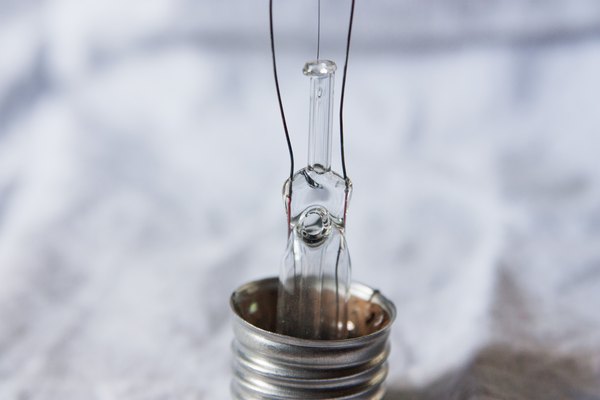
Within the inner center of the light bulb there is a centralized stem made from glass, which supports the filament in its place. The connecting wires ensure the steady flow of electricity through the components of the light bulb. Similar to the way the human heart works when blood travels to and from the heart, there is a wire that takes the electricity from the base of the light bulb and another wire that completes the electrical circuit back to the base.
Invisible Gases

Unseen within the light bulb are inert gases usually formed of argon and/or nitrogen. These low-pressure gases prevent the filament inside the bulb from burning out; it also relieves some of the stress on the glass globe from normal atmospheric pressure, lessening the chance of glass breakage.
The Base
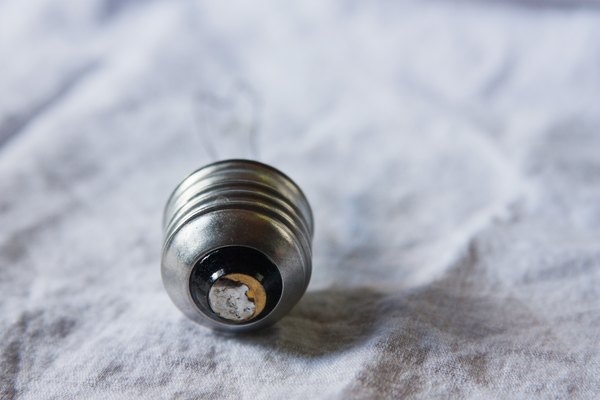
The base of the light bulb has three main functions. First, it securely supports the light bulb within an electrical source unit, like a lamp or a light fixture. The second job of the base is to transfer the electricity from the main electrical source to the inside of the light bulb itself. The last function is to secure the globe and all of the components inside the bulb, creating a reliable and convenient light source.
Ohm's Law of Electricity
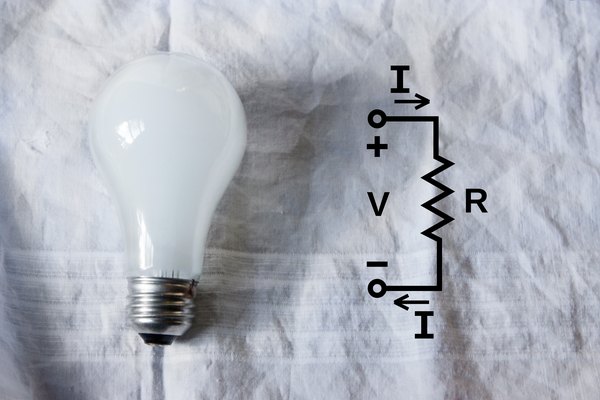
Georg Ohm first published his mathematical equation for the correct use of electricity in circuits in 1827. Ohm's law calculates the correct voltage of electricity given the current and resistance of any electrical circuit. Ohm's law was devised 27 years after the first light bulb was invented by Humphry Davy and 52 years before the American inventor, Thomas Edison, invented the first household light bulb.
References
About the Author
Based in Spain, Jennifer Burdett has been writing alternative medicine and health-related articles since 2007. Her work has appeared in "Inland Magazine" and in newspapers such as “Euro Weekly,” “Round Town News” and the “Sol Times.” Burdett received the Holistic Back Practitioner Asset Award in 2008 and qualified as a holistic back practitioner at StoneBridge College, U.K.