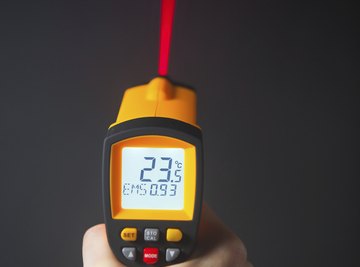

The purpose of heat sensors is to tell how hot or cold something is, but this is not a good description for how they work. What the sensors are actually measuring is the amount of atomic activity inside an object. This is what we think of as an object's temperature.
Particles and Heat
The measurement known as “absolute zero” describes a state of matter where there is no movement whatsoever inside an object, even at the subatomic level. It is the coldest state of matter. As soon as an object is heated, the particles inside it start to move. Heat sensors can pick up on this movement and measure it, which can be translated into a temperature.
Kinds of Sensors
The two basic type of heat sensors are traditional sensors and the more modern silicon-based sensors. Older sensors are often made up of devices that are known as thermocouples. A thermocouple is made of two metals that are welded together. Each welded part is called a junction. One junction of two dissimilar metals is then put at a reference temperature, such as zero degrees Celsius. The other junction of metals will be at the temperature you want to measure. The difference between the amount of particle excitement in each metal causes an electric current to develop. You can then measure the electric field to determine the temperature because the voltage will be temperature-dependent. This is called the Seebeck effect.
Advantages of Silicon Heat Sensors
Silicon temperature sensors are integrated circuits. Older sensors often require compensation or a buffer in order to work. Silicon sensors can process signals in a unit integrated with the sensor. Electricity is sent through the silicon and the resulting interaction between the electricity and the particles of the metal indicates a temperature.This means that they can operate over a much wider temperature spectrum than traditional sensors that require a compensator, ranging from 155 to -55 degrees Celsius.
Uses for Heat Sensors
Because these sensors measure the heat emitted by an object, also known as its infrared signature, they have advantages over other means of detection. This is because all objects give off a heat signature. This means that light does not have to reflect off the object for you to detect it. As a result, infrared sensors are used in night-vision goggles to help you see in the dark.
References
About the Author
Sam Morgan has a master's degree in environmental science and policy. Morgan has been interested in science writing since childhood, and enjoys writing about anything relating to science since it's challenging and interesting to learn about our world.
Photo Credits
nikkytok/iStock/Getty Images