
How to Make a Calf Roping Barrier
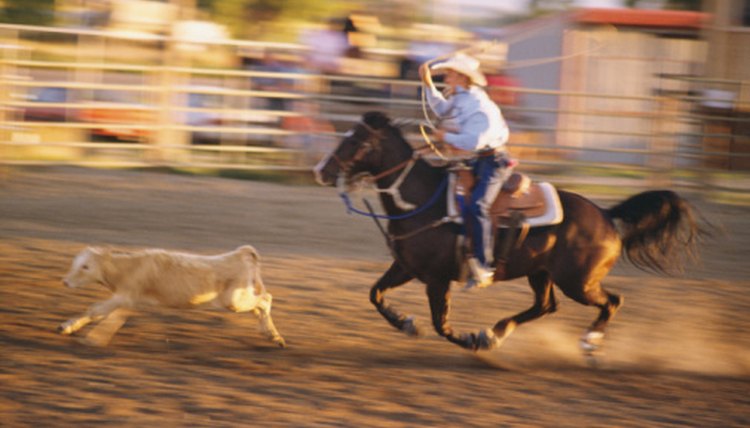
Dubbed America's original extreme sport, rodeos are a combination of events categorized as either "timed" or "rough stock." While rough stock events, such as bull riding, are judged; calf roping — commonly referred to as tie-down roping — and other events are strictly a race against the clock. Calf roping is timed using a barrier that allows the calf a predetermined head start. A barrier is a rope across the front of the box rigged to a breakaway collar on the calf. When the calf has gone a certain distance, the barrier is tripped and the cowboy can begin his pursuit of the calf.
Braid a section of rope not more than 10 inches long with the metal ring at one end and a loop on the other.
Create the breakaway collar by braiding a rope with loops at each end. Make the rope about 2 feet long. Tie the loops together using cotton string so that when the calf is released from the chute, he will easily break the two ends of the collar.
Attach the collar to the neck rope. Measure the neck rope according to the rodeo's official rules.
Tie the rope to a pigtail using cotton string. Pull it across the front of the box and through a pulley at the corner. Tie the end of the rope to the bungee cord and pull tightly. Secure the cord to the side of the roping box, ensuring that the barrier is 32 to 36 inches high.
Attach a flag to the center of the barrier when stretched across the front of the box. Time keepers watch for the movement of the flag to begin the official time.
Test the barrier to ensure it is working properly. With the barrier pinned at the corner, stand clear and pull the neck rope to release. The barrier should pull clear of the mouth of the box quickly. If it does not, tighten the bungee cord to create more tension.
Tips
In some cases, cotton string should be doubled to ensure proper functioning of the working parts of the barrier. This creates the pigtail which is tied to the barrier across the front of the roping box. The ring is used to "pin" the barrier to the neck rope and collar. When a contestant begins before the barrier is tripped, the string connecting the barrier to the pigtail will break. The neck rope represents the distance of head start given to the calf. The neck rope runs through a pulley wired to the chute and has the metal pin for the release mechanism of the barrier at the end. When the collar breaks away from the calf's neck, the pressure pulls the rope enough to pull the pin from the ring on the pigtail.
Warnings
Ensure that cotton string is strong enough to allow the neck rope to pull the pin on the barrier. Be certain that enough tension exists on the barrier to allow it to pull free of the mouth of the box; failing to do so can create dangerous conditions for contestants and their horses.
References
- Professional Rodeo Cowboys' Association (PRCA) Rulebook; 2011
- Jack Hannum; former Supervisor of Pro Officials, Professional Rodeo Cowboys' Association (PRCA); Ogden, Utah
Tips
- In some cases, cotton string should be doubled to ensure proper functioning of the working parts of the barrier.
- This creates the pigtail which is tied to the barrier across the front of the roping box. The ring is used to "pin" the barrier to the neck rope and collar. When a contestant begins before the barrier is tripped, the string connecting the barrier to the pigtail will break.
- The neck rope represents the distance of head start given to the calf. The neck rope runs through a pulley wired to the chute and has the metal pin for the release mechanism of the barrier at the end. When the collar breaks away from the calf's neck, the pressure pulls the rope enough to pull the pin from the ring on the pigtail.
Warnings
- Ensure that cotton string is strong enough to allow the neck rope to pull the pin on the barrier.
- Be certain that enough tension exists on the barrier to allow it to pull free of the mouth of the box; failing to do so can create dangerous conditions for contestants and their horses.