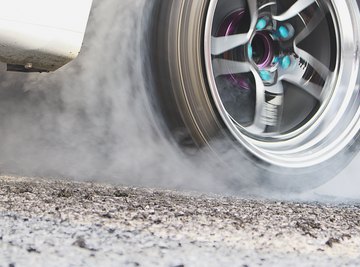

Friction occurs in two ways: kinetic and static. Kinetic friction acts on an object that slides across a surface, whereas static friction occurs when friction prevents the object from moving. A simple but effective model for friction is that the force of friction, f, is equal to the product of the normal force, N, and a number called the coefficient of friction, μ.
The coefficient is different for every pair of materials that contact each other, including a material that interacts with itself. The normal force is the force perpendicular to the interface between two sliding surfaces -- in other words, how hard they push against each other. There is a distinct coefficient of kinetic friction and coefficient of static friction for each scenario. These two types of friction help to describe how an object moves.
TL;DR (Too Long; Didn't Read)
The formula to calculate the coefficient of friction is μ = f÷N. The friction force, f, always acts in the opposite direction of the intended or actual motion, but only parallel to the surface.
Solving for the Coefficient of Kinetic Friction
Measure the Time of Movement
To measure the force of friction for a moving object – kinetic friction, set up an experiment in which a block, pulled by a string that runs over a pulley and is attached to a hanging mass, slides across a flat surface. Start the block as far from the pulley as possible, release the block, and record the time, t, it takes to move a distance, L, along the track. When the hanging mass is small, you may need to nudge the block very slightly to get it moving. Repeat this measurement with different hanging masses.
Tips
If the force of kinetic friction is equal to the applied force, it can result in a net force of zero and constant velocity (which can also be a constant velocity of zero, or no movement).
Calculate Friction Force
Calculate the friction force. To begin, first calculate the net force on the block:
where M is the mass of the block in grams, L is the length of the surface traveled, and t is the recorded time.
The applied force on the block is the pull from the string caused by the weight of the hanging mass, m. Calculate the applied force:
Calculate N, the normal force is the weight of the block:
Now, calculate the friction force, f, the difference between the applied force and the net force:
From this value we can then solve for the kinetic coefficient of friction μ using the relationship between normal force N, and friction force f:
Graph the Friction Force
We can also graph the friction force, f, on the y-axis against the normal force, N, on the x-axis. The slope will give you the kinetic friction coefficient. The slope acts to model the above formula to solve for the coefficient of friction.
Solving for the Coefficient of Static Friction
Place the object on the track at one end and slowly lift that end to make a ramp. Record the angle, θ, at which the block just begins to slide. At this angle, the effective force of gravity acting down the ramp is just barely greater than the friction force preventing the block from beginning to slide. Incorporating the physics of friction with the geometry of the inclined plane gives a simple formula for the static coefficient of friction:
where μ is the coefficient of static friction and θ is the angle of the inclined plane.
Why is the coefficient of friction important?
When we describe the forces on an object, a normal reaction might be to consider only the applied force from some outside source – maybe using Newton’s second law to find acceleration, but resistive forces like friction play an incredibly important role in modeling the movement of an object.
We can still use traditional kinematics and relationships of potential and kinetic energy to model systems, but we need to add in the force of static friction and dynamic friction with the friction equation to accurately describe our world.
Friction is found in all aspects of science and engineering. Materials might be purposefully engineered with large coefficients of friction – like tires that need traction or smaller coefficients of friction – like teflon used in non-stick pans and machinery.
References
Resources
About the Author
Ariel Balter started out writing, editing and typesetting, changed gears for a stint in the building trades, then returned to school and earned a PhD in physics. Since that time, Balter has been a professional scientist and teacher. He has a vast area of expertise including cooking, organic gardening, green living, green building trades and many areas of science and technology.