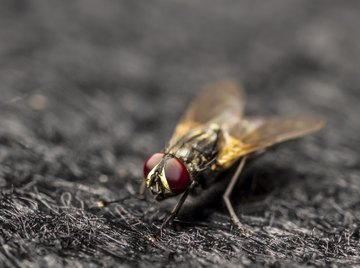

Small, fast and quick to reproduce, the fly is difficult to capture in the act of mating. Despite this, the study of fly reproduction has produced a large body of research. Current study reveals that flies employ a variety of reproductive strategies that are nothing short of sophisticated.
TL;DR (Too Long; Didn't Read)
The act of mating between two flies can take up to 2 hours.
The Strike
Mating begins when the male approaches the female. The male advances from any direction. Quickly, he will "strike" or jump toward the female. If the strike occurs in the air, the male and female will fall to a surface. If contact is made, the male generally lands on the dorsum (top) of the female's thorax, facing in the same direction as the female. The male's front pair of legs, the prothoracic and mesothoracic, will rest on the base of the female's wings. The metathoracic or hind legs of the male sit beneath the female's abdomen at the base of her wings. The female's wings extend out, vibrating rapidly and often accompanied by a loud buzzing sound. During the process, the female's hindmost (metathoracic) legs lift into the air and fold underneath her wings. Once in position, the male moves forward, stroking the head of the female with his foremost, prothoracic legs. During this stage, if the female has previously mated, she may struggle fiercely to extricate the male.
Copulation
Supposing the female does not shake him loose, the male will advance toward the rear of the female. Now he will place the ventral (bottom) part of his abdomen against her (top) dorsal abdominal segments. The front (prothoracic) legs of the male may now come to rest on the thorax or wings, the mesothoracic (middle) legs of the male may hang alongside the female's abdomen or on the base or top of her wings. His metathoracic (rear) legs will grasp onto the lower (ventral) portion of the female. Often his legs overlap crosswise. The female's wings will by now have resumed a normal positioning. During mating, the female thrusts her ovipositor into the genital opening of the male to obtain sperm from the male. Though flies are quick insects, their mating time is not. Mating may last anywhere from 30 minutes to 2 hours. Logically, longer mating time tends to result in greater number of useful sperm. Sperm is stored inside the female in the spermatheacae, which hold sperm until the ova are released from the ovaries. Once fertilized, the female releases eggs through her ovipositor, a cyclindrical body part that telescopes out as it directs eggs into suitable media, such as manure or rotting food.
The Monogamous Female, the Experienced Male
As a rule, the first male to mate fathers the vast majority, if not all, of the offspring. Once a female fly has mated, the spermatheacae will store sperm, and she will no longer need male assistance. The male, however, does not have such a luxury. He must work hard to promote his lineage. A little bit of hard work in the reproductive department does pay off for the male, though. In a study conducted by Texas A&M researchers, the non-virgin male fly showed a reproductive advantage. It appeared that the male was able to adapt his behavior, essentially learning from his prior experience, and gain success with his next conquest. Interestingly, excessive exploits had the opposite affect on the females, who would turn to a less experienced male when the other option was overly experienced.
Ladies' Choice
The bulk of sexual reproductive research on the fly has focused on mechanics and courting behavior, while the distinctive role of the female, as the final decision maker, has remain unstudied. Recently, the topic has gained interest. Particularly, the postulation that the female, though not the initiator, has the final say in copulation. Recent researchers have reported that two groups of neurons in the female fly's brain modulate reproduction based on his pheromones and courtship song. These groups of neurons either turn on or off during the key moment of interaction between the male and female.
References
- Public Library of Science: Sexual Experience Enhances Drosophila melanogaster Male Mating Behavior and Success
- giand.it: Flies
- Princeton University: What Singing Fruit Flies Can Tell Us About Quick Decisions
- Science World Report: What Happens in the Female Brain During Courtship and Mating? Fruit Flies Reveal All
- Ohio Journal of Science: Studies on the Mating Behavior of the House Fly, Musca Domestica L
About the Author
Based in California, Andrea Peck has been writing science-related articles since 2006. Her articles have appeared in "The Rogue Voice," "Information Press" and "The Tribune." Peck holds a Bachelor of Arts in mathematics and a minor in biology from San Diego State University.